啬
Character Story & Explanation
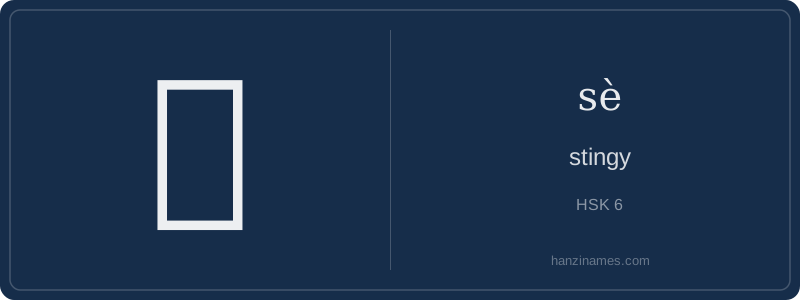
Historically, 啬 appears in early bronze inscriptions and the *Shuōwén Jiězì* (121 CE), where Xu Shen defines it as 'to conserve; to hoard' — linking it to agricultural storage and prudent resource management. In modern usage, it’s almost exclusively found in the compound 吝啬 (lìnsè), a standard term for 'miserliness' in textbooks, news reports on corruption, and literature critiquing greed. The phrase 吝啬鬼 (lìnsèguǐ, 'miser ghost') is a well-known idiom referencing Scrooge-like figures.
The character’s form likely evolved from a pictograph of grain stored in a granary with a lid (the top part resembling a covered container), later stylized. While oracle bone origins are uncertain, its seal script form clearly shows containment — reflecting its core idea of holding back or restricting resources.
Hi students! Let’s learn 啬 (sè), a Level 6 HSK character meaning 'stingy' or 'parsimonious'. Though it looks complex with 11 strokes, its structure is logical: the top part () suggests containment or restriction, and the bottom 十 (shí, 'ten') serves as both radical and structural anchor — not meaning 'ten', but helping organize the character. This isn’t a pictograph of a miser, but a phonosemantic compound refined over centuries.
Don’t confuse 啬 with common words like ‘cheap’ (pián 宜) or ‘frugal’ (jiǎn 俭). 啬 carries a strong negative connotation — implying excessive, unreasonable withholding, often of money, time, or effort. In classical texts like the *Dao De Jing*, 啬 appears in phrases like '治人事天,莫若嗇' ('In governing people and serving Heaven, nothing surpasses frugality'), where it reflects Daoist reverence for conservation — not stinginess, but wise restraint.
As an HSK 6 word, 啬 rarely appears alone in modern speech. You’ll almost always meet it in compounds like 吝啬 (lìnsè, 'miserly') or 爱啬 (àisè, 'overly protective/possessive'). Its tone is formal and literary; native speakers use it more in writing or criticism than casual chat. Mastering 啬 helps you read classical philosophy, understand nuanced critiques of behavior, and spot subtle shades of moral judgment in Chinese discourse.
Example Sentences
Common Compounds
Similar Characters — Don't Mix These Up
Your First Step into Chinese Culture: Get a Chinese Name
Every journey into Chinese begins with a name. Use our free Chinese name generator to create a meaningful, personalized Chinese name that fits you perfectly.
Get My Chinese Name →