也
Character Story & Explanation
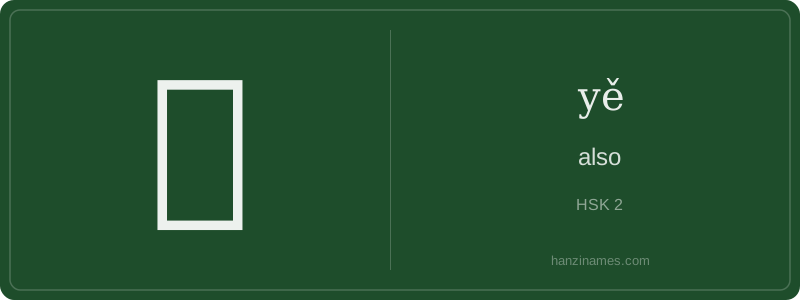
也 is one of the most frequent grammatical particles in Mandarin, appearing in over 95% of HSK 2+ dialogues and formal texts. It appears in fixed patterns like 也…也… (‘both… and…’) and 也不… (‘neither… nor…’), and is essential in comparative structures (e.g., 他也会说中文 — ‘He also speaks Chinese’). Historically, 也 served as a sentence-final particle in Classical Chinese to mark declarative certainty—still preserved in literary phrases like ‘是也’ (‘Indeed it is’).
The character’s earliest attested form appears in Warring States bamboo slips (4th c. BCE) as a simplified curve, likely evolving from a variant of 弋 (yì, ‘to shoot’), though its semantic origin remains debated among paleographers. No oracle bone form survives. Today, Chinese learners practice its three-stroke form daily: (vertical hook), ㇆ (horizontal curve), 乚 (final descending hook)—a minimalist gesture symbolizing connection and continuity.
The character 也 (yě) embodies a quiet yet profound aspect of Chinese relational thinking: inclusion without hierarchy. Unlike English 'also'—which often adds emphasis or contrast—也 flows softly, affirming shared identity or parallel condition. It doesn’t assert priority; it extends recognition. This mirrors Confucian ideals of harmony (hé 和), where difference coexists without division. In classical texts, 也 frequently closes declarative sentences—not as filler, but as a gentle seal of affirmation, like nodding in agreement.
Also deeply embedded in Chinese logic is the notion of ‘non-exclusive duality’: things can be both this *and* that, not either/or. 也 enables that fluid coexistence—‘I am tired, *also* I am happy’—without contradiction. This reflects Daoist yin-yang interdependence: reality isn’t binary but layered, interconnected. The character thus carries philosophical weight far beyond its grammatical function—it’s a linguistic vessel for relational ontology.
In modern usage, 也 subtly shapes social tone. Overusing it can sound evasive or overly conciliatory; omitting it where expected may seem abrupt or dismissive. Its placement signals empathy—e.g., saying ‘You’re busy? I’m busy *also*’ (你也忙) validates the other’s experience before asserting one’s own. This linguistic mirroring reinforces mutual respect, a cornerstone of Chinese interpersonal ethics. So 也 is not just ‘also’—it’s a cultural grammar of belonging.
Example Sentences
Common Compounds
Similar Characters — Don't Mix These Up
Your First Step into Chinese Culture: Get a Chinese Name
Every journey into Chinese begins with a name. Use our free Chinese name generator to create a meaningful, personalized Chinese name that fits you perfectly.
Get My Chinese Name →