嘈
Character Story & Explanation
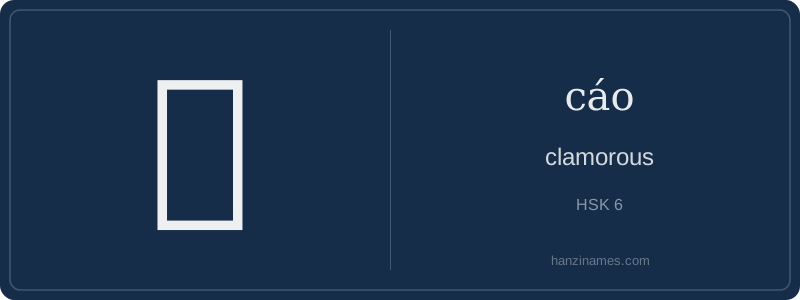
嘈 appears frequently in modern Mandarin to describe overwhelming auditory environments—especially in urban journalism, literature, and daily complaints. It features in the standard compound 嘈杂 (cáo zá, 'din' or 'clamor'), listed in the《现代汉语词典》(Contemporary Chinese Dictionary) and used by state media like Xinhua to describe crowded train stations or protest peripheries. Historically, it appears in Qing-dynasty vernacular novels like《儒林外史》to depict chaotic scholarly debates—showing its long-standing link to unstructured human discourse.
The character’s form is phono-semantic: 口 (kǒu, ‘mouth’) is the semantic radical, signaling sound-related meaning; 曹 (cáo) is the phonetic component, originally denoting a group or division (as in ancient bureaucratic units). No oracle-bone or bronze inscription evidence exists for 嘈—it emerged later in clerical script, reflecting the lexical need for a word describing dense, grating human noise in growing cities.
The character 嘈 (cáo) embodies a distinctly Chinese sensory philosophy: sound is never neutral—it carries social density, emotional texture, and moral weight. Unlike English ‘bustling,’ which often implies energetic positivity, 嘈 conveys an *overwhelming* auditory presence—crowded markets, argumentative banquets, or chaotic classrooms—where noise signals both vitality and potential disorder. This reflects the Confucian-adjacent value of harmony (和): too much unmodulated sound disrupts balance, making 嘈 subtly evaluative, not merely descriptive.
In classical Chinese aesthetics, auditory clutter was contrasted with the virtue of quietude (静). Poets like Du Fu used related terms to critique social unrest; 嘈 later crystallized this tension in vernacular writing as urban life intensified. Its radical 口 (mouth) anchors it in human utterance—not wind or machinery—but collective, uncoordinated speech, revealing how Chinese thought locates meaning in relational human activity, not isolated phenomena.
Modern usage preserves this cultural lens: 嘈 rarely appears alone but in compounds like 嘈杂 (cáo zá), where 杂 (‘mixed’) deepens the sense of disordered multiplicity. It’s seldom flattering—describing a ‘嘈杂的环境’ (noisy environment) implies discomfort, not excitement. This mirrors broader East Asian communication norms that privilege restraint and contextual awareness over expressive volume. Thus, 嘈 is less about decibels than about perceived social coherence—or its absence.
Example Sentences
Common Compounds
Similar Characters — Don't Mix These Up
Your First Step into Chinese Culture: Get a Chinese Name
Every journey into Chinese begins with a name. Use our free Chinese name generator to create a meaningful, personalized Chinese name that fits you perfectly.
Get My Chinese Name →