啸
Character Story & Explanation
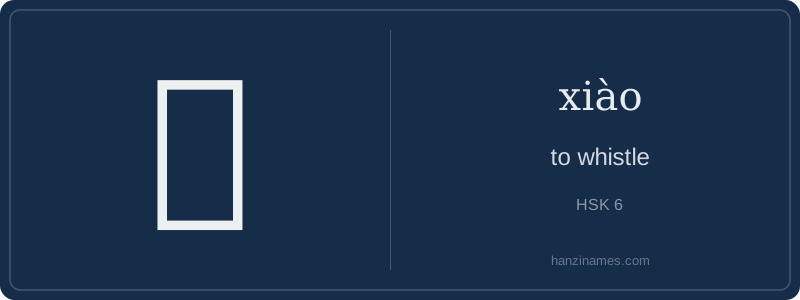
啸 is rare in modern spoken Chinese but retains strong presence in classical literature, poetry, and idioms. It appears in the famous idiom 龙吟虎啸 (lóng yín hǔ xiào), describing awe-inspiring, majestic sounds — historically used to depict the noble resonance of sages or heroes. Tang dynasty poets like Li Bai employed 啸 to evoke transcendence: '长啸倚青松' (cháng xiào yǐ qīng sōng) — 'long whistle leaning on green pines' — symbolizing untrammeled spirit. Modern usage survives in formal contexts: martial arts films, historical dramas, and classical music titles (e.g., the guqin piece 《啸旨》).
The character’s form is not pictographic but phono-semantic: 口 (mouth) is the semantic radical; 肅 (sù) is the phonetic component, though its pronunciation shifted over time (Old Chinese *suk > Middle Chinese *sjuH > Modern xiào). No oracle bone form exists — the earliest attestation is in Warring States bamboo slips, confirming its origin as a written compound, not a visual depiction.
Our detective begins at the crime scene: the character 啸, found inscribed in bronze vessels from the Warring States period (475–221 BCE) and later standardized in clerical script during the Han dynasty. Its radical 口 (mouth) immediately signals vocal action — not speech, but a controlled, resonant emission of air. The right component 肅 (sù), meaning 'solemn' or 'austere', is no mere decoration: it phonetically anchors the reading xiào while subtly reinforcing the disciplined breath control required for whistling — a sound both deliberate and expressive.
Zooming in on the brushwork: the 11 strokes unfold like a breath sequence — first the mouth frame (口), then the downward sweep of 肅’s head (聿-like stroke), followed by tight, descending lines mimicking exhalation under tension. Unlike casual shouting (叫) or singing (歌), 啸 demands diaphragmatic precision. Historical texts like the *Shishuo Xinyu* describe literati ‘whistling’ as a Daoist-inspired act of releasing qi — not just noise, but sonic cultivation. This isn’t background sound; it’s intentional resonance.
Modern forensic linguistics confirms 啸 remains phonosemantic: 口 defines domain (oral sound), 肅 provides both sound (xiào ≈ sù with tone shift) and semantic gravity. It never evolved into a generic verb for ‘make sound’ — unlike 呼 (hū, to call) or 吟 (yín, to chant). Its rarity in daily speech (HSK 6) reflects its literary weight: 啸 appears where sound carries philosophical or emotional weight — a lone scholar on a mountain ridge, wind in his sleeves, whistling to harmonize with nature. It’s less ‘whistle’ than ‘resonant utterance’ — a sonic signature of cultivated solitude.
Example Sentences
Common Compounds
Similar Characters — Don't Mix These Up
Your First Step into Chinese Culture: Get a Chinese Name
Every journey into Chinese begins with a name. Use our free Chinese name generator to create a meaningful, personalized Chinese name that fits you perfectly.
Get My Chinese Name →