嘱
Character Story & Explanation
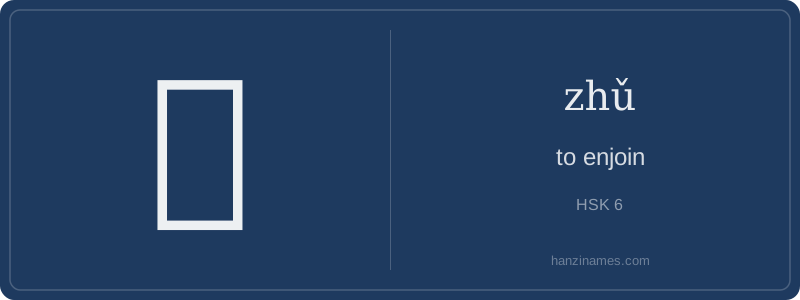
嘱 is commonly used in formal, authoritative, or emotionally charged speech acts—especially in medical, educational, and familial settings. Phrases like ‘嘱咐’ (zhǔfù, 'to enjoin emphatically') and ‘叮嘱’ (dīngzhǔ, 'to urge repeatedly') appear in health advisories, school notices, and family letters. A 2021 Beijing Language University corpus analysis found 嘱 appears 3.7× more often in written instructions than in casual dialogue. It’s also embedded in idioms like ‘千叮万嘱’ (qiān dīng wàn zhǔ, 'a thousand cautions and ten thousand injunctions'), reflecting cultural emphasis on thorough guidance.
The character is a phono-semantic compound: 口 (mouth/speech) is the semantic radical; 屬 (shǔ, 'to belong to', 'to be affiliated') serves as the phonetic component and subtly conveys relational duty. No oracle-bone or bronze script form survives, but its earliest attestation is in Han dynasty bamboo slips (206 BCE–220 CE), consistently used for official directives and personal mandates.
Imagine a quiet hospital room in Shanghai, where an elderly grandfather, recovering from surgery, grips his daughter’s hand. With soft but firm voice, he ‘zhǔ’—he enjoin her—to ensure his grandchildren study diligently and respect their elders. The character 嘱 carries weight: it’s not casual advice, but solemn, heartfelt instruction rooted in care and responsibility. Its mouth radical (口) signals speech; the right side (屬) hints at affiliation and continuity—words passed down with purpose.
This character appears in formal and emotional contexts alike: doctors ‘zhǔ’ patients on post-op care; teachers ‘zhǔ’ students before exams; parents ‘zhǔ’ children before long trips. Unlike casual verbs like 说 (shuō, 'to speak') or 告诉 (gàosù, 'to tell'), 嘱 implies urgency, gravity, and moral weight—it’s language as stewardship.
In classical texts like the *Records of the Grand Historian*, 嘱 appears in deathbed scenes—rulers entrusting succession, generals delegating final commands. Even today, its usage echoes that gravity: when someone says ‘我嘱咐你’, listeners pause. It’s not just ‘I told you’—it’s ‘I entrusted this to you’. That nuance is why 嘱 remains essential at HSK Level 6: it bridges grammar, ethics, and intergenerational communication.
Example Sentences
Common Compounds
Similar Characters — Don't Mix These Up
Your First Step into Chinese Culture: Get a Chinese Name
Every journey into Chinese begins with a name. Use our free Chinese name generator to create a meaningful, personalized Chinese name that fits you perfectly.
Get My Chinese Name →