所
Character Story & Explanation
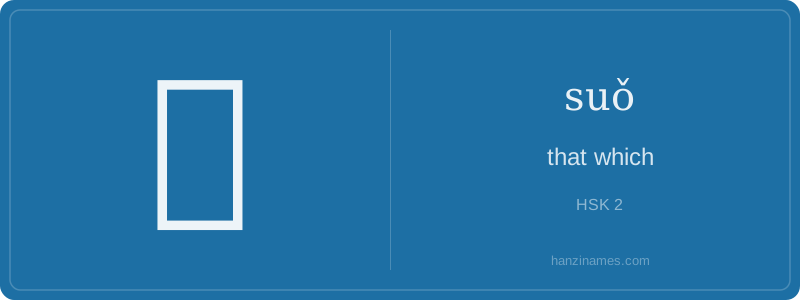
所 has been used since at least the Warring States period (475–221 BCE) in classical texts like the Zuo Zhuan to mark nominalized verb objects (e.g., 所爱 'that which is loved'). Today, it appears in high-frequency compounds like 所有 (suǒyǒu, 'to possess/all') and 所谓 (suǒwèi, 'so-called'), and in legal documents ('the said party') and news headlines ('the aforementioned policy'). It's indispensable in formal Chinese but rare in spoken slang.
The character evolved from oracle bone script, where its earliest form resembled a door (户) plus a symbol for 'place' or 'location'. Over time, it shifted grammatically from indicating physical space to marking abstract objects of action — a documented semantic broadening attested in bronze inscriptions and early bamboo manuscripts.
Hi students! Today we’re learning 所 (suǒ), an essential HSK Level 2 character with 8 strokes and the 户 (hù, 'door') radical. Don’t be misled by the dictionary label 'actually' — that’s only one nuance. In modern Chinese, 所 is rarely used alone. Instead, it functions as a structural particle, most often paired with 能 (néng), 有 (yǒu), or 以 (yǐ) to form grammatical constructions like 所能 (suǒ néng, 'that which can') or 所有 (suǒ yǒu, 'all/possess'). Think of it as a quiet helper that turns verbs into noun-like phrases.
This character carries a classical flavor — it originates from ancient Chinese grammar where 所 + verb marked the *object* of the action (e.g., 所见 = 'that which is seen'). Though less common in casual speech today, it remains vital in formal writing, news, laws, and idioms. You’ll see it constantly in compound words and fixed expressions, so mastering its patterns helps you read newspapers, official notices, and even social media posts with greater confidence.
One key tip: 所 always comes *before* a verb and *requires* another word after it — never use it solo like 'I am 所.' Also, note its pronunciation: suǒ (third tone, falling-rising), not 'suo' like 'sue-oh.' Practice writing it carefully — start with the 户 radical on the left (a simplified 'door'), then add the right-side component 尸 (shī, 'corpse') — but don’t worry about the morbid meaning; here it’s purely phonetic. Focus on stroke order and balance!
Example Sentences
Common Compounds
Similar Characters — Don't Mix These Up
Your First Step into Chinese Culture: Get a Chinese Name
Every journey into Chinese begins with a name. Use our free Chinese name generator to create a meaningful, personalized Chinese name that fits you perfectly.
Get My Chinese Name →