堡
Character Story & Explanation
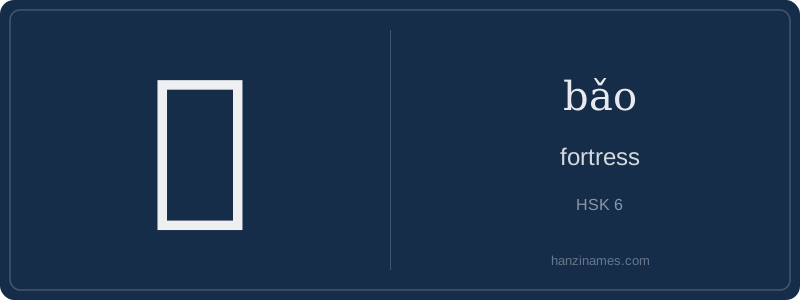
堡 is widely used in historical and geographical contexts across China. Famous examples include the Great Wall’s watchtowers — often called 碉堡 (diāo bǎo) — and countless village names ending in -堡 (e.g., Liángjiābǔ in Hebei), where bǔ reflects local dialect pronunciation preserved in official place names. The term also appears in modern military terminology and heritage preservation documents.
The character is not ancient: it first appeared in clerical script during the Han dynasty, combining 土 (earth, foundation) and 保 (to protect) as a semantic-phonetic compound. Its form wasn’t pictographic — no oracle bone or bronze inscriptions exist for 堡 — so it’s a later creation reflecting practical needs for naming fortified settlements.
Hi students! Let’s explore 堡 (bǎo), a character meaning 'fortress' or 'stronghold'. It’s built with the 土 (tǔ, 'earth/soil') radical on the left — showing its connection to earthen defensive structures — and 保 (bǎo, 'to protect') on the right, hinting at its core idea: a place built to protect people. Though it looks complex, remember that radicals guide meaning, and phonetic components often suggest pronunciation.
This character is pronounced bǎo in most modern contexts — like in 雪堡 (xuě bǎo, 'snow fortress', i.e., snow fort) or 碉堡 (diāo bǎo, 'blockhouse'). But historically and regionally — especially in northern Chinese place names — it’s read as bǔ, such as in Shānbǔ (山西山堡) or Wǔbǔ (五堡). This dual pronunciation reflects how spoken language evolves alongside geography and usage.
At HSK Level 6, 堡 appears in advanced reading about history, architecture, and regional culture. Don’t be intimidated by its 12 strokes — practice step-by-step using stroke-order rules: start with the radical 土, then write 保 carefully. Note that the top of 保 isn’t a dot but a short horizontal stroke, and the final stroke is a sweeping捺 (nà). Writing it slowly builds muscle memory and helps you recognize it in compound words.
Example Sentences
Common Compounds
Similar Characters — Don't Mix These Up
Your First Step into Chinese Culture: Get a Chinese Name
Every journey into Chinese begins with a name. Use our free Chinese name generator to create a meaningful, personalized Chinese name that fits you perfectly.
Get My Chinese Name →