堪
Character Story & Explanation
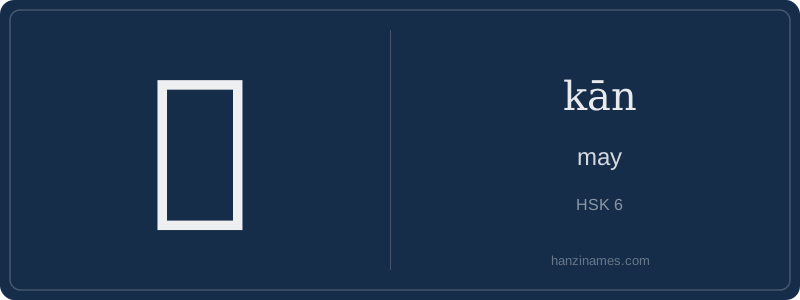
堪 is rarely used alone in modern Mandarin; it appears almost exclusively in formal compounds and classical-derived expressions. It features prominently in HSK 6-level idioms like 不堪一击 (bù kān yī jī, 'incapable of withstanding a single blow') and 堪称 (kān chēng, 'may rightly be called')—a phrase used by state media (e.g., Xinhua) to bestow authoritative recognition, such as 'this bridge may rightly be called an engineering marvel.' Historically, it appears in Tang dynasty poetry and Song legal texts to denote 'qualified for office' or 'fit to endure punishment.'
The character is not pictographic—it has no oracle bone or bronze script pictorial origin. Instead, it emerged as a phono-semantic compound in the Warring States period. Today, Chinese speakers encounter 堪 most often in written contexts: news headlines, academic writing, and exam essays—never in casual speech. A typical real-life use is editing a draft: '这个结论是否堪当定论?' ('Is this conclusion defensible as a definitive judgment?')
As a linguistic detective, I begin at the scene: the character 堪 appears in early seal script (c. 3rd century BCE) as a compound of 土 (earth, radical) and 甚 (shèn, 'extreme, excessive'), not a phonetic component alone—but a semantic-phonetic hybrid where 甚 hints both sound and intensity. Its original sense wasn’t abstract 'can' but concrete 'endurable'—as in bearing weight or hardship on solid ground. This groundedness is no accident: 土 anchors the idea in physical resilience.
By the Han dynasty, 堪 evolved into a modal verb marker meaning 'may', 'can', or 'be worthy of'—always implying qualification under pressure. Unlike 能 (néng, general ability) or 可 (kě, permission), 堪 carries evaluative gravity: it’s used when capacity is tested, judged, or affirmed after scrutiny. Think of it as the 'courtroom can': not just possibility, but *admissible* capability.
The character’s twelve strokes form a tight, balanced structure: 土 occupies the lower left, while 甚—simplified from its archaic form with ‘fire’ and ‘bladder’ components—now appears top-right. Modern standardization (1956–1964) streamlined 甚 to its current shape, yet preserved the critical tension between earth (stability) and extremity (demand). This duality explains why 堪 never means casual 'can'—it’s reserved for thresholds: endurance, judgment, or legitimacy.
Example Sentences
Common Compounds
Similar Characters — Don't Mix These Up
Your First Step into Chinese Culture: Get a Chinese Name
Every journey into Chinese begins with a name. Use our free Chinese name generator to create a meaningful, personalized Chinese name that fits you perfectly.
Get My Chinese Name →