墅
Character Story & Explanation
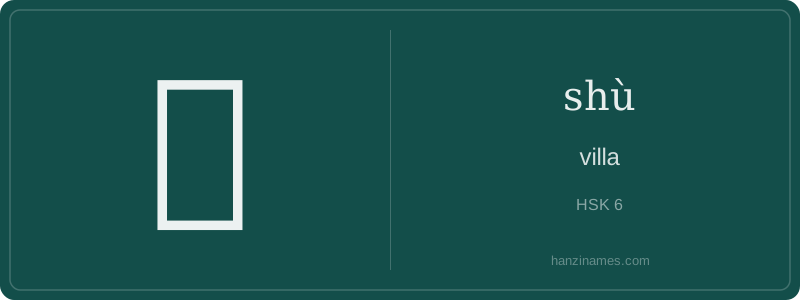
In contemporary Chinese, 墅 appears almost exclusively in the compound 别墅 (biéshù), meaning 'villa'—a term ubiquitous in real estate ads, property listings, and lifestyle media. It is rarely used alone; no native speaker says *‘我家有墅’*—it’s always embedded in compounds. Historically, it appears in Tang-Song literary records referring to scholar-officials’ secondary residences, such as Wang Wei’s famous ‘Wangchuan Villa’ (辋川别业), though 别业 (bièyè) was more common then; 墅 gained dominance post-Ming as vernacular usage shifted.
The character has no pictographic origin—it’s a phono-semantic compound: 土 (tǔ, ‘earth’, semantic) + 野 (yě, ‘wilderness’, originally phonetic but semantically resonant). Though the modern right component resembles 野, it’s actually a cursive-derived simplification. In daily life, Chinese see 墅 on property signs, WeChat housing groups, and luxury brochures—always signaling affluence, space, and separation from urban density.
As an archaeologist brushing dust from a Tang-dynasty stele fragment, I found 墨迹未干的‘墅’ carved beside a land deed—its 土 radical anchoring it firmly in earthbound reality, not myth. Unlike poetic characters born of celestial omens, 墅 emerged pragmatically: a compound of 土 (earth/land) and 野 (wilderness, open country), signaling a cultivated retreat *beyond* the city walls—a suburban estate where literati composed poetry away from bureaucratic clamor.
This character bears no oracle-bone pedigree; it first appears reliably in mid-Tang texts like Bai Juyi’s letters, describing his ‘Luda villa’ (庐山别墅) near Mount Lu. Its 14 strokes encode intentionality: the left side grounds ownership (土), while the right (野 → simplified to 野’s phonetic-semantic remnant, now written as 野 without full form) evokes seclusion. No divine mandate—just elite land-use strategy made lexical.
By the Song dynasty, 墅 had fossilized into a socio-architectural marker: not just ‘house’, but *detached*, *landed*, *leisure-oriented*. Excavations at Kaifeng’s suburban ruins reveal inscribed tiles bearing ‘某某别墅’—proof that branding villas was already a status practice. The character never meant ‘hut’ or ‘mansion’; it occupied a precise niche: private, rural-adjacent, cultured residence. Its survival into modern Mandarin confirms how deeply material culture shapes script.
Example Sentences
Common Compounds
Similar Characters — Don't Mix These Up
Your First Step into Chinese Culture: Get a Chinese Name
Every journey into Chinese begins with a name. Use our free Chinese name generator to create a meaningful, personalized Chinese name that fits you perfectly.
Get My Chinese Name →