墓
Character Story & Explanation
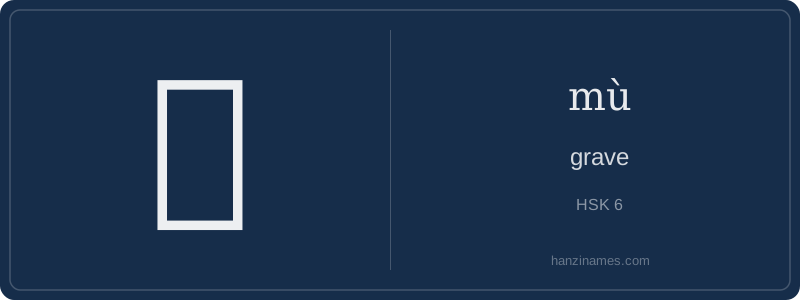
In modern China, 墓 is central to Qingming Festival (Tomb-Sweeping Day), when millions visit ancestral graves to clean, offer food, and burn joss paper—a practice documented since the Song dynasty and still mandated by local civil affairs bureaus for cemetery management. Common phrases include 墓碑 (mùbēi, tombstone) and 公墓 (gōngmù, public cemetery), the latter regulated under China’s 2021 Funeral Management Regulations.
The character’s form is not pictographic but phono-semantic: 土 (tǔ, earth) signals meaning; 莫 (mò, archaic for ‘dusk’) provides sound and symbolic resonance—reflecting the ancient association of burial with sunset and the underworld. No oracle bone form exists; the earliest attested use is in Warring States bamboo texts, where it consistently denotes a constructed burial site, not a natural pit.
As an archaeologist brushing dust from a Han dynasty bamboo slip, I find 墓 etched with quiet solemnity—not as a mere marker of death, but as a ritual anchor. Its 土 (earth) radical reveals ancient cosmology: the grave was not an end, but a threshold where the living maintained cosmic balance through earth-bound offerings. The right side, 莫, originally depicted the sun setting behind grasses—evoking twilight, transition, and the liminal space between realms.
This character’s 13 strokes encode layered meaning: the horizontal lines in 莫 suggest enclosure and containment, while the 土 base grounds the concept literally and spiritually. Unlike Western 'grave'—often associated with finality—墓 carries ancestral veneration, continuity, and territorial claim over sacred ground. Excavations at Mawangdui confirm that tomb inscriptions used 墓 to denote both physical structure and metaphysical status, revealing its role in bureaucratic afterlife administration.
Over centuries, 墓 evolved from elite burial markers (e.g., imperial mausoleums like the Ming Tombs) into standardized administrative terminology. By the Tang, it appeared in land registers specifying ‘grave plots’ (墓地) as legally protected zones—proof that this character functioned as both spiritual signifier and legal instrument. Its HSK Level 6 placement reflects not just rarity, but conceptual density: mastering 墓 means grasping how Chinese civilization materializes memory, kinship, and cosmic order in soil.
Example Sentences
Common Compounds
Similar Characters — Don't Mix These Up
Your First Step into Chinese Culture: Get a Chinese Name
Every journey into Chinese begins with a name. Use our free Chinese name generator to create a meaningful, personalized Chinese name that fits you perfectly.
Get My Chinese Name →