坟
Character Story & Explanation
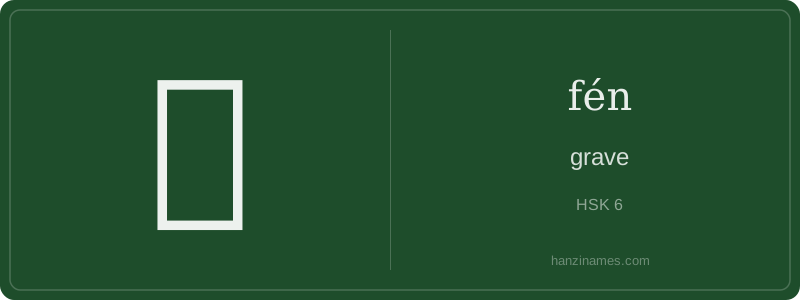
In modern Chinese, 坟 appears most commonly in historical, literary, or respectful contexts—not daily conversation. It features in idioms like 坟头长草 (fén tóu zhǎng cǎo, 'grass grows on the grave'), meaning 'someone has been dead for a long time', and in official terms like 烈士坟 (lièshì fén, 'martyrs’ grave'). The State Administration of Cultural Heritage regulates its use in heritage sites, and it appears in place names like 香山万安公墓 (Xiāngshān Wàn’ān Gōngmù), though 公墓 ('cemetery') is now preferred over 坟 for public burial grounds.
The character is a phono-semantic compound: 土 (tǔ, 'earth') as semantic radical, and 文 (wén, 'culture/writing') as phonetic component—though the pronunciation shifted from *bun* in Middle Chinese to fén today. Its earliest attested form appears in Warring States bamboo manuscripts (c. 475–221 BCE), where it consistently denotes an earthen burial mound—not a pit or vault, but a raised, visible marker.
As an archaeologist brushing dust from a Han dynasty stele, I find 坟 not as a static symbol of death—but as a layered cultural artifact. Its 土 (earth) radical anchors it in the physical world: graves were literally mounded earth, distinguishing them from tombs with chambers or stone markers. Early texts like the Book of Rites prescribe mound height by social rank—proving this character encoded hierarchy long before ink dried on bamboo slips.
This character’s simplicity belies its ritual weight. Unlike later tomb architecture, the ‘mound’ was the primary grave marker for centuries—visible, measurable, and deeply tied to feng shui. Excavations at Mawangdui revealed that even elite burials retained earthen mounds over lacquered coffins, confirming 坟 as both practical boundary and cosmological anchor—linking the living soil above to the ancestral realm below.
What’s striking is how 坟 resisted abstraction. While many characters evolved pictorially into stylized forms, 坟 retained its semantic clarity: earth + ‘to cover’ (the right component, now simplified to 文). No oracle bone form survives, but bronze inscriptions from the Warring States period already use it consistently for ‘burial mound’. This stability suggests it emerged not from myth, but from agrarian necessity—marking land, memory, and lineage in one compact glyph.
Example Sentences
Common Compounds
Similar Characters — Don't Mix These Up
Your First Step into Chinese Culture: Get a Chinese Name
Every journey into Chinese begins with a name. Use our free Chinese name generator to create a meaningful, personalized Chinese name that fits you perfectly.
Get My Chinese Name →