妆
Character Story & Explanation
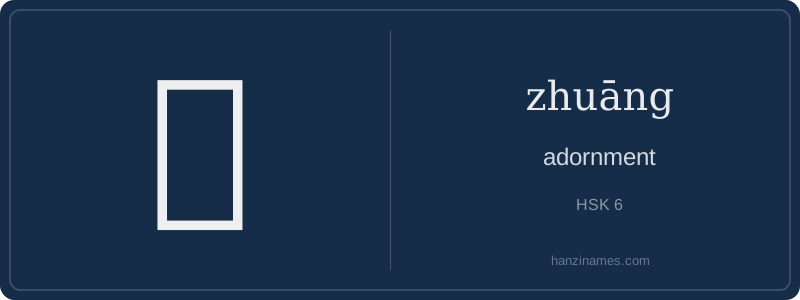
In modern Chinese life, 妆 is ubiquitous in daily vocabulary: ‘化妆’ (huàzhuāng, ‘to apply makeup’) appears in beauty tutorials, dermatology clinics, and wedding planning. It features in idioms like ‘浓妆艳抹’ (nóng zhuāng yàn mǒ, ‘heavy makeup and bright pigment’), historically used in Ming-Qing fiction to describe courtesans or theatrical performers—documented in the 16th-century novel ‘Jin Ping Mei’. The term also anchors legal terminology: ‘整容妆’ (zhěngróng zhuāng, ‘cosmetic surgery-related appearance’) appears in China’s 2021 Medical Cosmetology Regulations.
The character’s seal script form (c. 3rd century BCE) clearly combines 女 (female) and 壮 (phonetic, pronounced zhuàng), with no pictographic origin—it’s a phono-semantic compound. No oracle bone inscriptions contain 妆; its earliest verified usage is on Warring States bamboo manuscripts, where it consistently denotes ritual beautification tied to status and occasion.
As an archaeologist sifting through layers of linguistic sediment, I uncover 妆 not as a static glyph but as a ritual artifact—its earliest attested form in the Warring States bamboo slips (c. 475–221 BCE) already bears the female radical 女 and the phonetic component 壮 (zhuàng), signaling both gendered practice and vocal resonance. This isn’t mere decoration: it’s evidence of ancient self-presentation as social technology—cosmetics, hairpins, and rouge were encoded in bureaucracy, marriage contracts, and medical texts.
The character’s six-stroke structure reveals deliberate design: the left-side 女 (nǚ, ‘woman’) grounds it in embodied, gendered labor; the right-side 壮 (zhuàng, ‘strong, robust’) was borrowed for sound but subtly evokes vigor—adornment as empowerment, not passivity. Excavations at Mawangdui (168 BCE) unearthed lacquer cosmetic boxes with vermilion powder and jade applicators, confirming that 妆 denoted a codified, multi-step regimen—not improvisation, but discipline.
By the Tang dynasty, 妆 had crystallized into a lexical anchor for identity performance: court ladies’ ‘feathered eyebrow’ makeup (羽妆) was documented in imperial records, while poets like Bai Juyi used 妆 to critique performative femininity in ‘The Song of Everlasting Sorrow’. Its HSK-6 status reflects how deeply it permeates literary nuance—not just ‘makeup’, but the ethics, aesthetics, and economics of self-construction across millennia.
Example Sentences
Common Compounds
Similar Characters — Don't Mix These Up
Your First Step into Chinese Culture: Get a Chinese Name
Every journey into Chinese begins with a name. Use our free Chinese name generator to create a meaningful, personalized Chinese name that fits you perfectly.
Get My Chinese Name →