姆
Character Story & Explanation
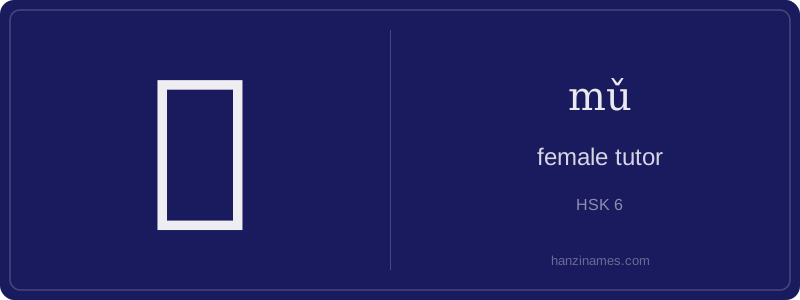
Historically, 姆 appeared in Qing-dynasty household records and Republican-era novels to denote educated women employed as tutors or caretakers for daughters of scholar-official families — distinct from wet nurses (乳母, rǔmǔ) or general maids. Today, it survives almost exclusively in compounds: 保姆 (bǎomǔ) is the most common term for 'nanny' or 'live-in caregiver', widely used in urban job platforms and childcare regulations. Official documents from China’s Ministry of Human Resources (e.g., 2021 Domestic Service Regulations) consistently use 保姆, not standalone 姆.
The character is not pictographic. Its earliest attested form appears in clerical script (Lìshū) during the Han dynasty, combining 女 (female) and 母 (mother) — reflecting its semantic roots in maternal instruction. While 母 emphasizes biological motherhood, 姆 highlights socially sanctioned, skilled female pedagogy — a documented distinction in pre-modern Confucian education texts.
Hello, learners! The character 姆 (mǔ) is a beautiful example of how Chinese characters encode meaning and social roles. It belongs to the 女 (nǚ, 'female') radical family — instantly signaling its connection to women’s traditional occupations. Though it looks simple with only eight strokes, every line reflects historical respect for female educators. Don’t confuse it with similar-sounding characters like 母 (mǔ, 'mother') — while related in pronunciation and tone, 姆 specifically denotes a professional role: a woman hired to teach or care for children, especially in elite or formal settings.
Think of 姆 as a respectful title — like 'governess' in English, but more culturally specific. In modern usage, it’s rarely used alone; instead, it appears in compound words such as 保姆 (bǎomǔ, 'nanny') or 女仆 (nǚpú, 'maid'), where it carries connotations of trained, responsible caregiving. Its HSK Level 6 status means it’s not beginner vocabulary, but mastering it helps you understand nuanced social hierarchies and historical gendered labor terms in Chinese texts.
When reading classical or early 20th-century literature — like works by Ba Jin or Ding Ling — you’ll encounter 姆 in contexts describing household staff in wealthy families. Even today, in formal job listings or legal documents about domestic employment, 姆 retains its precise, dignified sense. Pronounce it with the third tone (mǔ), a falling-rising pitch — practice saying 'mǔ' while imagining gently correcting a child’s handwriting. That mental image aligns perfectly with the character’s quiet authority!
Example Sentences
Common Compounds
Similar Characters — Don't Mix These Up
Your First Step into Chinese Culture: Get a Chinese Name
Every journey into Chinese begins with a name. Use our free Chinese name generator to create a meaningful, personalized Chinese name that fits you perfectly.
Get My Chinese Name →