娃
Character Story & Explanation
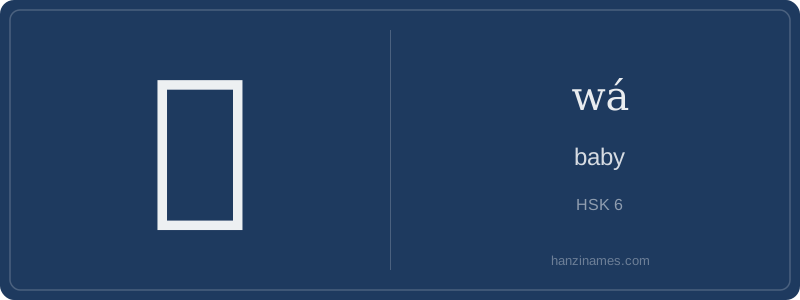
娃 is widely used across northern and central China in daily speech — especially in affectionate, diminutive contexts. It appears in common phrases like ‘俺家娃’ (ǎn jiā wá, ‘my family’s child’) and is embedded in folk expressions such as ‘抱娃’ (bào wá, ‘to hold a baby’) and regional idioms like ‘娃不离手’ (wá bù lí shǒu, ‘the baby never leaves one’s hands’), reflecting strong caregiving norms. It’s documented in Ming–Qing vernacular literature and modern dialect studies (e.g., Beijing and Shaanxi speech corpora) as a core kinship term.
The character 娃 first appeared in Song–Yuan period texts as a colloquial variant; its form combines 女 (female radical) and 瓦 (phonetic component). While 瓦 originally meant ‘roof tile’, it contributes only sound here — no pictographic link to babies. There’s no oracle-bone or bronze inscription evidence; it’s a later, phonosemantic creation for spoken language.
Hi students! Let’s learn 娃 (wá), a warm, affectionate word for 'baby' or 'young child' — especially used in spoken Mandarin and regional dialects like Northern Chinese. Unlike the formal term 孩子 (háizi), 娃 carries tenderness and familiarity, often appearing in nicknames, lullabies, and everyday talk between parents and grandparents. It’s not used in official documents or academic writing, but you’ll hear it constantly in homes, markets, and TV dramas.
This character is built from two parts: the left-side radical 女 (nǚ, 'woman/female'), which hints at nurturing and family roles, and the right side 瓦 (wǎ, 'tile/roof tile') — which here serves only as a phonetic clue (wá sounds close to wǎ). Though 娃 looks simple, its emotional weight is big: it evokes innocence, care, and intergenerational closeness.
At HSK Level 6, 娃 appears less in textbooks and more in authentic materials — think folk songs like 《小兔子乖乖》(‘Little Bunny, Be Good!’) where ‘兔娃’ (tù wá, ‘bunny-baby’) pops up playfully. Remember: it’s almost always colloquial and rarely stands alone — usually part of compound words like 娃娃 (wáwa) or 小娃 (xiǎo wá). Don’t confuse it with formal terms like 婴儿 (yīng’ér); 娃 is your grandma calling your toddler ‘my little one’ — soft, loving, and very human.
Example Sentences
Common Compounds
Similar Characters — Don't Mix These Up
Your First Step into Chinese Culture: Get a Chinese Name
Every journey into Chinese begins with a name. Use our free Chinese name generator to create a meaningful, personalized Chinese name that fits you perfectly.
Get My Chinese Name →