嫉
Character Story & Explanation
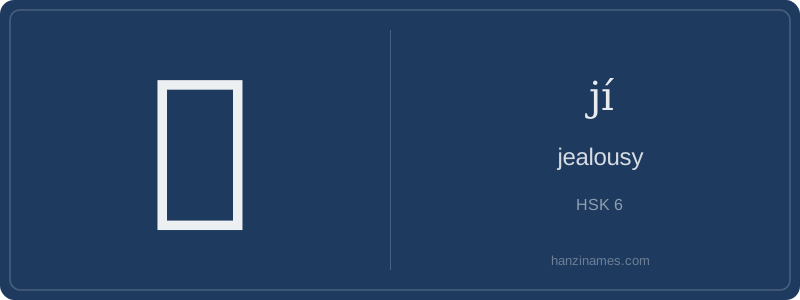
In modern Chinese, 嫉 appears almost exclusively in formal, literary, or critical contexts — rarely in casual speech (where people say 羡慕 xiànmù 'admire' or 嫉妒 jídù 'jealousy' instead). It’s common in written media, psychological discourse, and classical allusions: the idiom '嫉贤妒能' (jí xián dù néng) — 'to envy the virtuous and begrudge talent' — appears in Sima Qian’s *Records of the Grand Historian* and remains a stock phrase in political commentary.
The character’s form has no pictographic origin; it emerged in seal script (c. 3rd century BCE) as a phono-semantic compound: 女 (radical, semantic field) + 疾 (phonetic and conceptual anchor). Today, Chinese learners encounter it most often in HSK 6 reading passages about human psychology or historical critique — not in daily chit-chat, but in essays analyzing leadership failures or literary characters’ moral flaws.
As a linguistic detective, I begin with the radical: 女 (nǚ), meaning 'woman' — not because jealousy is gendered, but because classical Chinese often categorized emotions linked to interpersonal dynamics under this radical (e.g., 妒 dù 'envy', 婚 hūn 'marriage'). This reflects ancient sociolinguistic framing, where relational feelings were grouped by social role, not biology.
The right side, 疾 (jí), means 'illness' or 'sudden onset' — and here it’s a phonetic-semantic compound. It contributes both sound (jí) and connotation: jealousy isn’t passive dislike; it’s an acute, destabilizing affliction — historically described in medical texts like the *Huangdi Neijing* as a 'heart-fire disorder' disrupting qi flow. The character thus encodes an embodied, pathological view of envy.
Unlike modern Western individualism, 嫉 carries moral weight in Confucian ethics: it’s one of the 'seven emotions' (七情) that must be regulated. Mencius warned that unchecked 嫉 erodes ren (benevolence). Its 13-stroke structure — compact yet tense — mirrors its semantic urgency: no flourish, no redundancy, just sharp containment of volatile feeling.
Example Sentences
Common Compounds
Similar Characters — Don't Mix These Up
Your First Step into Chinese Culture: Get a Chinese Name
Every journey into Chinese begins with a name. Use our free Chinese name generator to create a meaningful, personalized Chinese name that fits you perfectly.
Get My Chinese Name →