孔
Character Story & Explanation
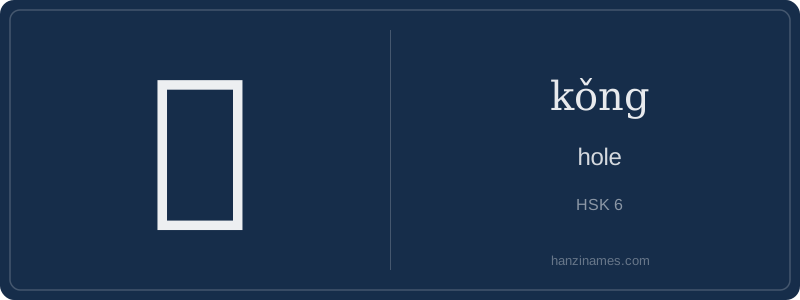
孔 is widely used in contemporary Chinese for technical and everyday terms involving openings: speaker holes (喇叭孔), ventilation holes (通风孔), and even figurative expressions like 突破口 (tūpòkǒu, 'breakthrough point'—literally 'break-through hole'). It appears in the HSK-6 idiom 毛孔 (máokǒng, 'pore') and the standardized term for USB ports (USB接口, where 接口 jǐnkǒu means 'interface'—with 孔 embedded in the concept). Historically, it appears in pre-Qin bronze inscriptions denoting casting vents in ritual vessels.
The character is a simplified form of the ancient pictograph depicting a small round opening—early seal script shows a circular shape with a dot or line inside, representing a drilled aperture. By the Han dynasty, it stabilized into its current structure: 子 (radical, originally unrelated phonetic component) + 乚 (a curved stroke suggesting enclosure or depth), reflecting sound borrowing rather than pictographic continuity.
The Chinese character 孔 (kǒng) is a deceptively simple four-stroke glyph whose primary meaning is 'hole' or 'aperture'—a physical opening, like a keyhole, pore, or gap. Though visually minimal, it carries conceptual weight in both concrete and abstract domains: from engineering schematics specifying drill-hole dimensions to poetic metaphors for insight ('a hole into truth'). Its radical 子 (child) hints at historical semantic evolution—not biological but structural smallness or foundational origin.
Unlike English 'hole', which often connotes absence or deficiency (e.g., 'black hole', 'loophole'), 孔 tends toward neutral or functional connotations: a necessary passage, channel, or interface point. In classical texts, it appears in technical contexts (e.g., ritual bronze vessel perforations) and philosophical metaphors—Confucius’s surname (Kǒng) ironically shares the character, though etymologically unrelated; this homophony later inspired playful scholarly wordplay but no semantic link.
In modern usage, 孔 anchors precise technical vocabulary—mechanical tolerances, acoustic resonance, or microfluidics—where accuracy matters more than imagery. Western equivalents like 'orifice' (medical), 'aperture' (optics), or 'bore' (engineering) are domain-specific synonyms, yet none replicate 孔’s lexical versatility across science, craft, and idiom. Its brevity and stability across millennia underscore how Chinese characters encode functional semantics compactly—unlike alphabetic systems where meaning disperses across spelling and context.
Example Sentences
Common Compounds
Similar Characters — Don't Mix These Up
Your First Step into Chinese Culture: Get a Chinese Name
Every journey into Chinese begins with a name. Use our free Chinese name generator to create a meaningful, personalized Chinese name that fits you perfectly.
Get My Chinese Name →