宇
Character Story & Explanation
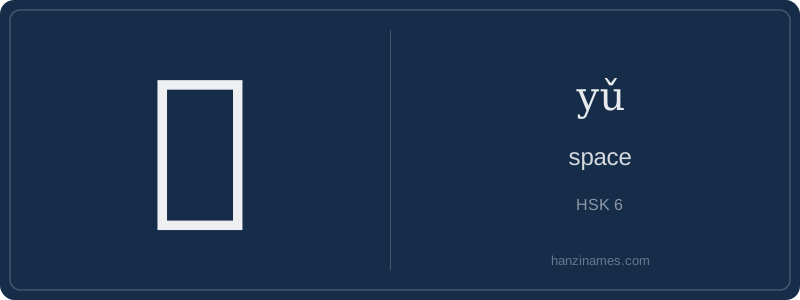
In modern Chinese, 宇 most commonly appears in formal or literary contexts—not in daily talk about ‘rooms’ (which uses 房间 or 屋). It's central to compound words like 宇宙 (yǔzhòu, ‘universe’) and 气宇轩昂 (qìyǔ xuān’áng, idiom meaning ‘magnificent bearing’). Historically, it appears in classical poetry and Confucian texts to denote dignified, spacious dwelling—e.g., in the Book of Rites, describing the proper scale of ancestral halls.
The character is not pictographic but phono-semantic: 宀 (roof) + 于 (phonetic, yú). Oracle bone or bronze script forms of 宇 are unattested; earliest secure examples appear on Warring States bamboo texts (c. 475–221 BCE). Today, Chinese people encounter 宇 primarily in written compounds—especially in news headlines about space exploration (e.g., 神舟飞船返回地球宇航员安全着陆), reinforcing its elevated, expansive connotation.
As an archaeologist sifting through bamboo slips from the Warring States period, I found 宇 inscribed not as a humble room—but as the cosmic canopy: the space beneath heaven’s roof. Its radical 宀 (mián), meaning 'roof,' anchors the character in shelter, while the phonetic component 于 (yú) hints at resonance and extension. Early texts like the Shijing use 宇 to evoke both ancestral halls and the vault of heaven—blurring domestic and celestial boundaries.
This duality persisted into Han dynasty cosmology: 宇 appeared alongside 廟 (temple) and 宮 (palace), signaling sacred enclosure. Excavated bronze inscriptions show 宇 paired with verbs like ‘to dwell’ (居) and ‘to enshrine’ (奉), confirming its ritual weight. It was never merely four walls—it was the first architecture of meaning: where human life met the infinite.
By the Tang dynasty, poets like Du Fu deployed 宇 to compress vastness into intimacy—‘a single 宇 holds ten thousand stars.’ Modern excavations of Dunhuang manuscripts reveal scribes using 宇 in administrative documents to denote official residence quarters. Even today, its six-stroke form retains that ancient tension: sheltering yet expansive, bounded yet boundless—proof that language preserves stratified time, layer upon layer, like sediment in an excavation trench.
Example Sentences
Common Compounds
Similar Characters — Don't Mix These Up
Your First Step into Chinese Culture: Get a Chinese Name
Every journey into Chinese begins with a name. Use our free Chinese name generator to create a meaningful, personalized Chinese name that fits you perfectly.
Get My Chinese Name →