等
Character Story & Explanation
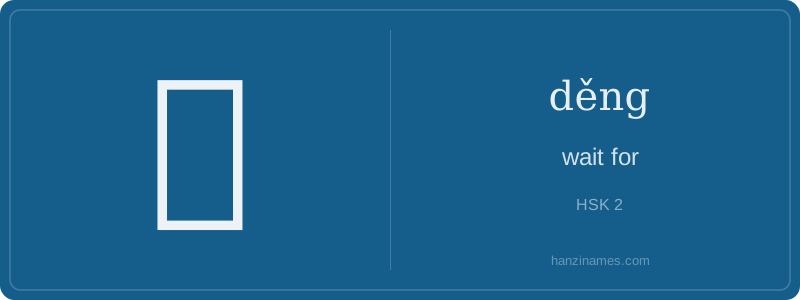
等 is ubiquitous in daily Chinese communication: from subway announcements (‘Please wait for the doors to close’ → 请稍等) to formal documents (‘etc.’ in legal clauses). It appears in the common phrase 稍等一下 (shāo děng yí xià, 'wait a moment') and idioms like 等闲视之 (děng xián shì zhī, 'to treat lightly'), where its original 'waiting' sense has metaphorically evolved to mean 'treating something as ordinary, thus not worth urgent attention'. Historically, 等 was used in Tang dynasty poetry and Song legal texts to denote conditional expectation or hierarchical parity (e.g., 等级, 'rank').
The character’s form combines the bamboo radical ⺮ (suggesting writing slips, historically used for lists/records) with 寺 (sì, 'temple, office')—not as a pictograph, but as a phono-semantic compound. While 寺 provided sound (archaic pronunciation close to *děng*), ⺮ hints at systematic categorization—fitting its later use in enumeration (e.g., A、B、C等). No oracle bone form survives; earliest attestation is in Warring States bamboo manuscripts, where it consistently means 'to await' or 'to rank equally'.
The Chinese character 等 (děng) fundamentally conveys the idea of 'waiting for' or 'awaiting'—a state of patient anticipation rooted in relational and temporal awareness. Unlike English verbs that often emphasize agency ('I wait'), 等 frequently appears in constructions implying shared or socially embedded waiting, such as waiting for a person, a signal, or a condition to be met. Its usage reflects Confucian-influenced values where timing, propriety, and mutual expectation matter more than individual urgency.
In modern Mandarin, 等 extends beyond literal waiting into grammatical functions: it serves as a list-ender (e.g., 'coffee, tea, etc.' → 咖啡、茶等), signaling non-exhaustive enumeration—a nuance absent in English ‘etc.’ which lacks verbal weight. This dual role—as both action verb and syntactic marker—makes it uniquely versatile. Western equivalents like ‘wait’ or ‘await’ rarely carry this grammatical load, highlighting how Chinese integrates meaning and syntax more tightly.
Culturally, 等 embodies a pragmatic patience distinct from Western notions of passive idleness. In contexts like queuing, customer service, or digital interfaces (e.g., ‘loading… please wait’ → 请稍等), 等 signals respectful suspension—not delay as failure, but as necessary alignment. Compare this to English-speaking cultures where ‘waiting’ may imply inefficiency; in Chinese, 等 often carries quiet dignity, echoing classical ideals of *shí* (時, timeliness) — acting only when conditions harmonize, not merely when clocks tick.
Example Sentences
Common Compounds
Similar Characters — Don't Mix These Up
Your First Step into Chinese Culture: Get a Chinese Name
Every journey into Chinese begins with a name. Use our free Chinese name generator to create a meaningful, personalized Chinese name that fits you perfectly.
Get My Chinese Name →