宫
Character Story & Explanation
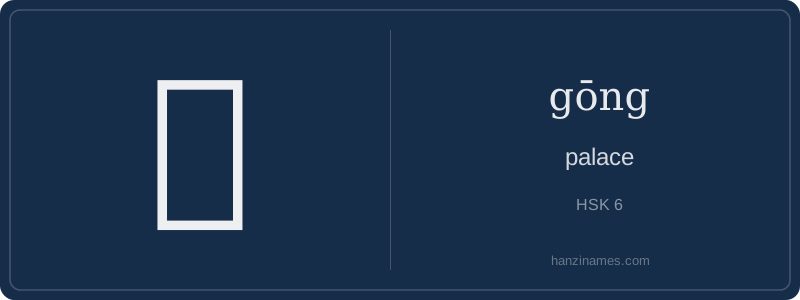
Historically, 宫 appears ubiquitously in imperial nomenclature: the Forbidden City is Gùgōng (故宫, 'Former Palace'), and Beijing’s Summer Palace includes Wànhé Gōng (万和宫, though more commonly Yíhé Yuán). It remains central in modern usage: ‘palace’ in cultural institutions (e.g., 少年宫 shàonián gōng, 'Children’s Palace'), and in compound terms like 宫廷 (gōngtíng, 'imperial court'). A well-documented idiom is 深宫 (shēn gōng, 'deep palace'), referencing secluded imperial consorts—frequently in Tang poetry and historical dramas.
The character’s origin is documented: bronze script forms show 宀 over 吕 (originally picturing two flanking pillars or chambers), not a mythical ‘nest’ or ‘crown’. Today, Chinese learners first encounter 宫 in place names (e.g., 故宫博物院 Gùgōng Bówùyuàn, the Palace Museum) and education compounds—making it a lexical anchor for history, architecture, and social structure.
As a linguistic detective, I begin at the oracle bone and bronze inscriptions—though 宫 doesn’t appear in earliest oracle bones, its earliest secure form emerges in Western Zhou bronze script (c. 1000 BCE) as a roof (宀) over two enclosed chambers, suggesting a walled, multi-roomed elite residence. This wasn’t yet ‘palace’ as imperial symbol, but a high-status dwelling—often for ancestral rites—reflecting early Chinese social hierarchy anchored in architecture and ritual space.
By the Warring States period, 宫 evolved graphically: the lower component stabilized as 吕 (two mouth-like units stacked), representing symmetrical, columned halls—likely inspired by actual timber-frame palace layouts with paired pillars and interlocking brackets. The radical 宀 (roof) remained dominant, anchoring meaning in ‘covered, authoritative space’. This visual logic persisted through seal script and clerical script, resisting simplification precisely because of its institutional weight.
In the Qin–Han transition, 宫 acquired unmistakable political gravity: the First Emperor’s Epang Palace (阿房宫) and Han’s Weiyang Palace (未央宫) were monumental complexes where 宫 denoted not just buildings but sovereign authority incarnate. Later, it extended metaphorically—to celestial palaces (e.g., 紫微宫, the ‘Purple Forbidden Enclosure’ in astronomy) and even to bodily ‘palaces’ in Daoist internal alchemy. Its semantic expansion mirrors China’s cosmological worldview: earthly power mirrored heavenly order, both housed in ‘palaces’.
Example Sentences
Common Compounds
Similar Characters — Don't Mix These Up
Your First Step into Chinese Culture: Get a Chinese Name
Every journey into Chinese begins with a name. Use our free Chinese name generator to create a meaningful, personalized Chinese name that fits you perfectly.
Get My Chinese Name →