尖
Character Story & Explanation
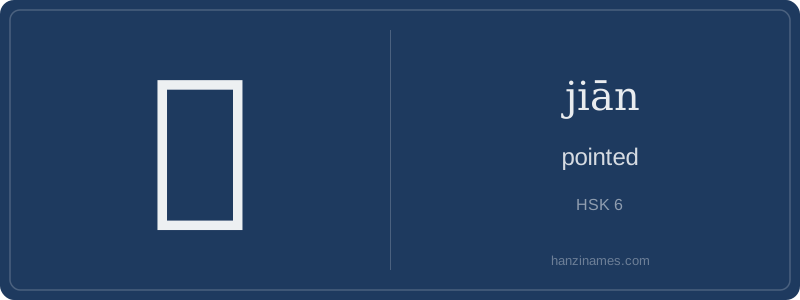
尖 is widely used in contemporary Chinese across technical, colloquial, and educational contexts. It appears in the standardized term 尖子生 (jiānzi shēng)—‘top-performing student’—a phrase documented in Ministry of Education reports since the 1980s and commonly used in school rankings. The idiom 尖酸刻薄 (jiān suān kè bó), meaning ‘caustic and sarcastic’, has appeared in Qing-dynasty vernacular fiction like *The Scholars* (Rulin Waishi, c. 1750) and remains in daily use to describe biting wit or hostility.
The character’s earliest attested form appears in Han-dynasty clerical script (c. 206 BCE–220 CE), where it clearly combines 小 (small) above 隹 (zhuī, ‘short-tailed bird’—a common phonetic-semantic component). Though not a pictograph, its structure reflects an early association between ‘smallness at the top’ and ‘pointedness’. Today, Chinese learners practice it early as a model for stroke-order discipline: dot, left-falling stroke, right-falling stroke, horizontal, vertical,捺 (nà).
The Chinese character 尖 (jiān) visually embodies its meaning: a small (小) element placed atop a large (大) one—though the lower component is actually the ancient form of 'bird' (隹, zhuī), later stylized. This composition suggests something that rises to a narrow, concentrated point—like a mountain peak or a needle’s tip. In classical usage, it emphasized precision and intensity, not just physical sharpness but also acuity of mind or sound.
In modern Mandarin, 尖 extends metaphorically far beyond geometry: it describes high-pitched voices (尖声), cutting criticism (尖刻), and elite status (尖子生). Unlike English ‘sharp’, which can imply intelligence (‘sharp mind’) or danger (‘sharp knife’), 尖 carries stronger connotations of piercing intensity, sometimes with negative overtones—e.g., being overly critical or shrill. Its semantic range reflects how Chinese prioritizes perceptual immediacy: what *pierces the ear*, *pricks the eye*, or *cuts through convention*.
Western equivalents vary by domain: ‘pointed’ (geometric), ‘shrill’ (acoustic), ‘cutting’ (verbal), or ‘elite’ (social). Yet no single English word captures 尖’s unified imagery of convergence-to-a-point—whether in shape, sound, intellect, or hierarchy. This conceptual unity mirrors East Asian aesthetic values: think of the ‘sharp’ brushstroke in ink painting or the ‘sharp’ pitch in Peking opera, both valued for their focused energy and expressive economy.
Example Sentences
Common Compounds
Similar Characters — Don't Mix These Up
Your First Step into Chinese Culture: Get a Chinese Name
Every journey into Chinese begins with a name. Use our free Chinese name generator to create a meaningful, personalized Chinese name that fits you perfectly.
Get My Chinese Name →