岩
Character Story & Explanation
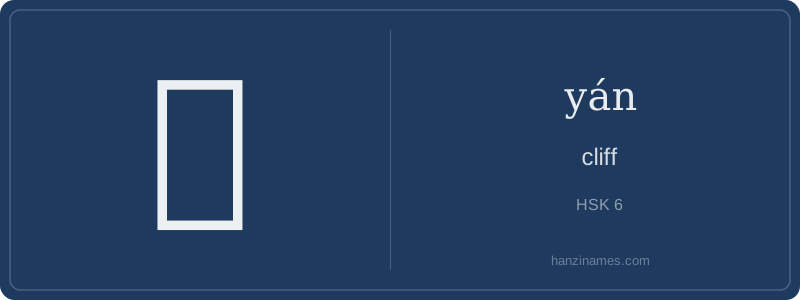
岩 is widely used in modern Chinese for geological terms (e.g., 岩石 yánshí 'rock'), place names (e.g., 黄岩 Huángyán District in Zhejiang), and idioms like 岩岩若山 (yán yán ruò shān, 'towering like a mountain'—praising solemn dignity). Historically, it appears in Tang dynasty poetry describing frontier landscapes and Ming-Qing travelogues documenting mountainous terrain. The term 崖岩 (yá yán) was used interchangeably with 崖 (cliff-face) in pre-modern texts, emphasizing vertical geological structure.
The character is a phono-semantic compound: 山 (shān, mountain) as semantic radical signals meaning domain, while 严 (yán, originally 'strict') serves as phonetic component—though pronunciation shifted slightly over time. No oracle-bone or bronze inscriptions exist for 岩; it first appears reliably in Han dynasty bamboo slips as a variant for cliff-related meanings, confirming its later derivation from 山 + 严.
岩 (yán) embodies the Chinese reverence for mountains not as mere geography, but as enduring witnesses to time and vessels of cosmic qi. Its radical 山 (mountain) anchors it in the Daoist and Confucian understanding of mountains as moral exemplars—unshakable, silent, and generative. In classical poetry and landscape painting, cliffs symbolize both spiritual aspiration and the sublime indifference of nature, reflecting a worldview where humanity seeks harmony, not conquest, with geological permanence.
The character’s simplicity—just eight strokes—belies its philosophical weight. Unlike Western ‘cliff’ (often associated with danger or isolation), 岩 evokes resilience, mineral authenticity, and quiet authority. It appears in place names like Yan’an (‘Peaceful Cliff’) and scholarly terms like 岩石学 (petrology), linking geology to cultural memory. This duality—raw nature and refined study—mirrors the Chinese ideal of cultivating inner strength through observation of natural constancy.
In traditional medicine and feng shui, rock formations influence energy flow; thus, 岩 subtly carries connotations of grounding and stability. Even today, calling someone 岩石般坚定 (as firm as rock) praises unwavering integrity—not rigidity, but rooted adaptability. This reflects a core Chinese value: true strength arises not from resistance, but from deep alignment with natural order, much like a cliff shaped by wind and water over millennia yet standing unbroken.
Example Sentences
Common Compounds
Similar Characters — Don't Mix These Up
Your First Step into Chinese Culture: Get a Chinese Name
Every journey into Chinese begins with a name. Use our free Chinese name generator to create a meaningful, personalized Chinese name that fits you perfectly.
Get My Chinese Name →