峭
Character Story & Explanation
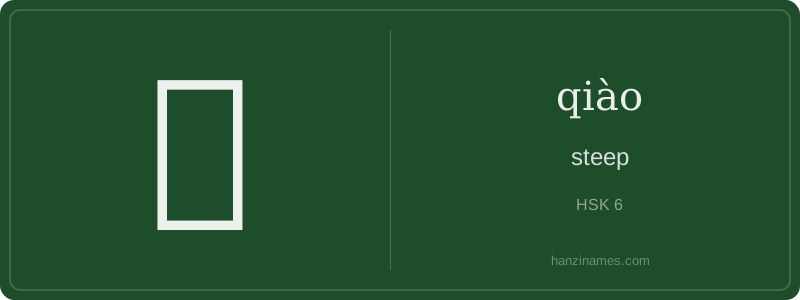
In classical and modern Chinese, 峭 appears frequently in geographical descriptions, poetry, and literary criticism. It’s central to the idiom 峭壁千仞 (qiào bì qiān rèn)—'a precipice a thousand ren high'—used since the Tang to evoke awe-inspiring, impassable cliffs. Modern writers like Shen Congwen deploy it to describe both landscape and moral austerity: 'his prose is 峭而清' ('sharp yet lucid'). In official geography textbooks and tourism signage, 峭 consistently modifies nouns like 壁 (cliff), 岩 (rockface), and 岸 (bank).
The character is not pictographic; no oracle bone or bronze inscription bears 峭. Its earliest attested form is seal script (c. 3rd c. BCE), showing 山 + a phonetic component now evolved into 少. Today, Chinese hikers label trail maps with '峭路段' (steep-section path), and journalists use 峭转 (qiào zhuǎn, 'abrupt turn') to describe sudden policy shifts—proving its semantic resilience beyond geology.
Unearthing 峭 from the stratigraphy of Chinese script reveals not a pictorial cliff face, but a calculated semantic fusion: the 山 (mountain) radical anchors its terrain, while the 口 (mouth) and 刀 (knife) components—now stylized into the right-hand 立 and 少—once evoked sharpness and verticality in early clerical script. This isn’t a snapshot of rock, but a lexical compression of geological tension: height that defies ascent, slope that resists foothold.
The character first appears reliably in Han dynasty texts like the *Shuōwén Jiězì* (121 CE), where Xu Shen defines it as ‘jùn qiào’—‘steep and precipitous’—confirming its core meaning was already fixed and technical. Unlike characters born from oracle-bone divination, 峭 emerged from administrative and descriptive needs: surveying borders, mapping mountain passes, or recording imperial tours through perilous terrain.
Its ten-stroke form stabilized during the regular script (kǎishū) standardization under the Tang, shedding earlier cursive variants that blurred the distinction between 少 and 刀. The modern shape is thus less an ancient fossil and more a calibrated instrument—a precision term for topography that later extended metaphorically to tone, style, and temperament: a voice can be 峭, a critique can be 峭, because steepness implies unyielding clarity, not mere difficulty.
Example Sentences
Common Compounds
Similar Characters — Don't Mix These Up
Your First Step into Chinese Culture: Get a Chinese Name
Every journey into Chinese begins with a name. Use our free Chinese name generator to create a meaningful, personalized Chinese name that fits you perfectly.
Get My Chinese Name →