峻
Character Story & Explanation
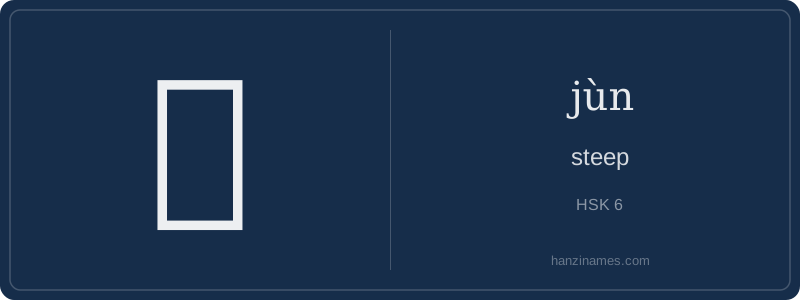
峻 appears frequently in modern Chinese geographical terminology and formal writing—for example, in official reports on mountainous regions, railway engineering (e.g., ‘峻坡’ jùn pō, 'steep gradient'), and historical texts describing natural barriers. It’s essential in the idiom 崇山峻岭 (chóng shān jùn lǐng), used since at least the Tang Dynasty to evoke majestic, impassable terrain—cited in Du Fu’s poetry and modern textbooks alike.
The character’s form dates to the seal script (c. 3rd century BCE), where 山 clearly depicts mountain peaks, and 夋 (qūn) served as a phonetic marker. Unlike pictographs such as 日 (sun), 峻 is not a direct visual imitation but a semantic-phonetic compound—its meaning anchored by 山, its sound guided by 夋. Today, Chinese speakers use it most often in written descriptions of topography, architecture challenges, or metaphorical 'steep' difficulties (e.g., 峻烈的考验 jùn liè de kǎoyàn, 'severe test').
Hi students! Let’s explore 峻 (jùn), a character that means 'high'—but not just any kind of high. It describes steep, towering, imposing height: think of a sheer mountain cliff or a sharp, dramatic rise. It’s not used for gentle slopes or tall buildings alone; it carries a sense of awe, severity, and natural grandeur. This nuance is key—you’ll rarely hear 峻 describing a ladder or a shelf!
Notice the radical 山 (shān)—'mountain'—on the left. That tells us immediately this character relates to terrain and elevation. On the right is 夋 (qūn), which originally suggested movement upward and later became a phonetic component. Together, they form a character that evokes vertical power and majesty, often used in literary or formal contexts rather than casual speech.
Although 峻 is an HSK Level 6 word (advanced), you’ll encounter it in classical poetry, news headlines about geography or infrastructure, and idioms like 崇山峻岭 (chóng shān jùn lǐng, 'lofty mountains and steep ridges'). Don’t confuse it with similar-sounding words like 俊 (jùn, 'talented')—they share pronunciation but differ radically in meaning and writing. Practice writing it slowly: 10 strokes, starting with the mountain radical!
Example Sentences
Common Compounds
Similar Characters — Don't Mix These Up
Your First Step into Chinese Culture: Get a Chinese Name
Every journey into Chinese begins with a name. Use our free Chinese name generator to create a meaningful, personalized Chinese name that fits you perfectly.
Get My Chinese Name →