们
Character Story & Explanation
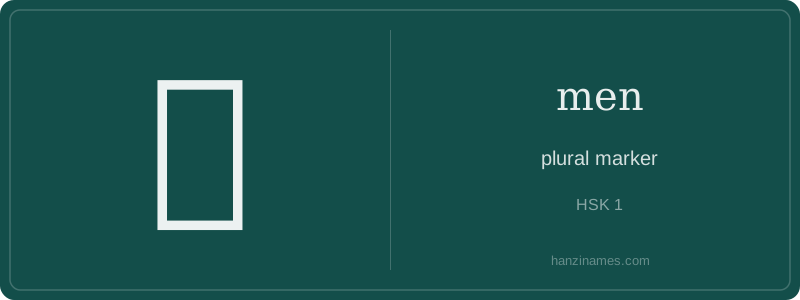
们 has been used as a plural marker since at least the Ming and Qing dynasties in vernacular literature, appearing frequently in novels like Water Margin and Dream of the Red Chamber to indicate groups of people—e.g., 咱们 (zánmen, 'we/us, inclusive') and 他们 (tāmen, 'they'). In modern Mandarin, it’s indispensable in spoken and written Chinese: news headlines say '老师们' (teachers), schools post notices about '同学们' (classmates), and even WeChat group names often end in 们—like '吃货们' ('food lovers'). It’s never used for non-human nouns in standard usage.
The character evolved from the ancient form 們, with the 亻 (person) radical clearly indicating human reference. Its right side (门, mén, 'door') was originally phonetic but no longer reflects pronunciation. No oracle bone or bronze script form exists for 们—it emerged later in clerical script during the Han dynasty as a grammatical innovation for marking human plurals.
Hi students! Today we’re learning 们 (men), a tiny but essential character in Chinese. It’s not a standalone word—it’s a plural marker used only after pronouns like 我 (wǒ, 'I') or nouns referring to people, such as 老师 (lǎoshī, 'teacher'). So 我们 means 'we', 你们 means 'you (plural)', and 老师们 means 'teachers'. Unlike English, Chinese doesn’t change verb forms for plurality—们 does all the work! It’s one of the first characters you’ll use daily because it makes speech sound natural and inclusive.
Remember: 们 can *only* attach to words that refer to people—not objects, animals, or abstract concepts. You’ll never say 书们 ('books') or 猫们 ('cats'); that’s grammatically incorrect. Also, it’s rarely used with formal or honorific titles alone (e.g., not *校长们* without context)—but in casual speech, adding 们 to names like 小明们 (Xiǎo Míng men) is common among friends to mean 'Xiao Ming and his group'.
As an HSK Level 1 character, 们 appears early because it unlocks basic communication. Though only 5 strokes, its shape is easy to remember: it starts with the person radical 亻 (left side), then has three short strokes—two slanted dots and a horizontal line—like little people standing together. Practice writing it slowly: 丿 → 丨 → 丶 → 丶 → 一. Mastering 们 helps you shift from 'I' to 'we', from 'you' to 'you all'—a small stroke with big social power!
Example Sentences
Common Compounds
Similar Characters — Don't Mix These Up
Your First Step into Chinese Culture: Get a Chinese Name
Every journey into Chinese begins with a name. Use our free Chinese name generator to create a meaningful, personalized Chinese name that fits you perfectly.
Get My Chinese Name →