崩
Character Story & Explanation
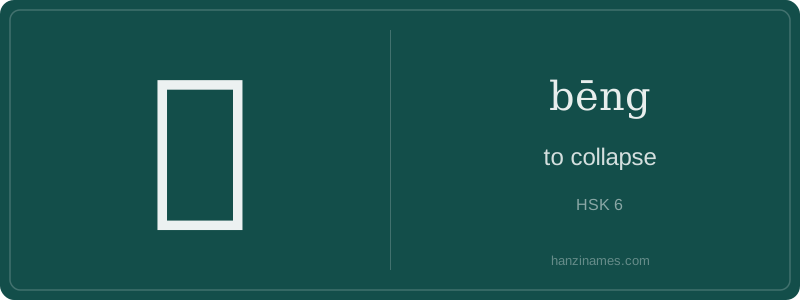
In contemporary Chinese, 崩 appears most frequently in formal, high-stakes contexts: news reports on financial crashes (股市崩盘), historical accounts of dynastic collapse (王朝崩溃), and technical warnings about system failures (服务器崩溃). It’s central to the idiom 山崩地裂 (shān bēng dì liè), meaning 'cataclysmic disruption', documented since the Book of Han (1st c. CE). Government documents use it for state emergencies—e.g., the 2008 Sichuan earthquake reports described '山体崩塌' (mountain-body collapse).
The character’s form is not pictographic but phono-semantic: 山 (mountain) as semantic radical signals natural/structural disaster; 朋 (péng) serves as phonetic component—though pronunciation shifted from *bēng* to *péng* in Old Chinese. No oracle bone or bronze script forms survive, confirming its late emergence during the Warring States period (5th–3rd c. BCE), likely coined for bureaucratic precision in recording royal deaths and disasters.
As an archaeologist brushing dust from a Han dynasty bamboo slip, I find 崩 etched not as abstract decay—but as a mountain’s violent rupture. Its radical 山 (mountain) anchors the character in geological reality, while the phonetic component 朋 (péng) once signaled resonance: a collapse so profound it echoed across valleys. Early texts like the Zuo Zhuan use it exclusively for royal death—'the mountain fell'—a euphemism so potent it avoided naming mortality directly.
This wasn’t metaphorical flourish; it reflected cosmological belief: the emperor was the axis mundi, and his death mirrored tectonic upheaval. Excavated Western Han funerary inventories list ‘崩’ in mourning protocols—never for commoners. The character’s eleven strokes encode ritual gravity: each horizontal sweep mimics crumbling rock strata; the final捺 (nà) stroke plunges like a landslide’s terminus.
By the Tang dynasty, semantic expansion began—‘collapse’ extended to dynasties, economies, and even data systems—but the core remained visceral. Modern dictionaries still cite ‘山崩地裂’ (mountain collapse, earth split) as its archetypal compound. Even today, Chinese news outlets avoid using 崩 for ordinary accidents; its weight demands scale, consequence, or systemic failure—proof that ancient semantic boundaries endure beneath modern usage.
Example Sentences
Common Compounds
Similar Characters — Don't Mix These Up
Your First Step into Chinese Culture: Get a Chinese Name
Every journey into Chinese begins with a name. Use our free Chinese name generator to create a meaningful, personalized Chinese name that fits you perfectly.
Get My Chinese Name →