巢
Character Story & Explanation
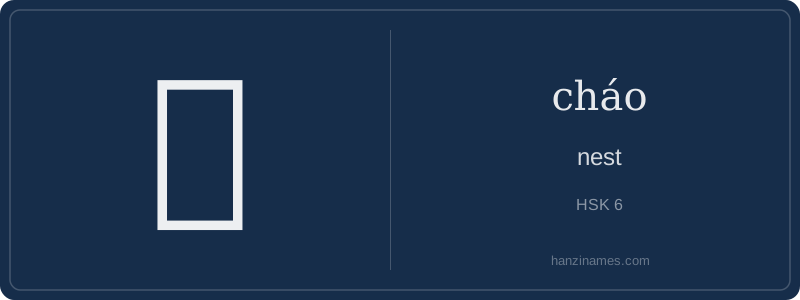
In modern Chinese, 巢 appears most frequently in compound words rather than standalone usage. It’s central to terms like 巢穴 (cháo xué, 'lair' or 'den'), often used metaphorically for criminal hideouts or corrupt power bases—e.g., official anti-corruption reports describe dismantling ‘corruption nests’ (反腐巢穴). The idiom 筑巢引凤 (zhù cháo yǐn fèng, 'build a nest to attract phoenixes') is widely cited in policy documents promoting talent recruitment and urban development.
Archaeologically, the character’s form is a stylized depiction of a woven twig nest atop a branch—confirmed by early seal script variants showing clear vertical support lines beneath intertwined curves. Though not an oracle bone character, its earliest secure attestation is in Warring States bamboo manuscripts, where it consistently represents avian habitation.
Our detective work begins with the oracle bone and bronze inscriptions—though 巢 does not appear in the earliest oracle bones, its form stabilizes by the Warring States period. The character clearly depicts a bird’s nest: three curved strokes (巛) at the top suggest woven twigs or branches, while the lower part (果) originally represented a fruit-bearing tree—symbolizing a sheltered, fertile place where birds rest and raise young. This visual logic reflects ancient Chinese observation of nature as a source of linguistic symbolism.
By the Han dynasty, 巢 was standardized in clerical script, retaining its structural duality: the radical 巛 (originally meaning 'flowing water' but repurposed here for 'interwoven strands') signals semantic association with structure and enclosure, while 果 (guǒ, 'fruit') acts as a phonetic component hinting at pronunciation—though modern cháo diverges from guǒ’s sound, this is a common phonetic shift seen across characters like 裸 (luǒ) and 颗 (kē). Historical dictionaries like the Shuōwén Jiězì (121 CE) explicitly define 巢 as 'a bird’s dwelling built of twigs.'
The character’s evolution reveals how Chinese writing balances pictorial memory and functional abstraction. While no longer a literal drawing of a nest, its eleven-stroke composition preserves an intuitive gestalt: layered curves above a grounded base evoke shelter, containment, and organic construction. This makes 巢 unusually transparent among HSK-6 characters—a rare case where form, meaning, and etymological logic remain coherently aligned for modern learners willing to look closely.
Example Sentences
Common Compounds
Similar Characters — Don't Mix These Up
Your First Step into Chinese Culture: Get a Chinese Name
Every journey into Chinese begins with a name. Use our free Chinese name generator to create a meaningful, personalized Chinese name that fits you perfectly.
Get My Chinese Name →