廉
Character Story & Explanation
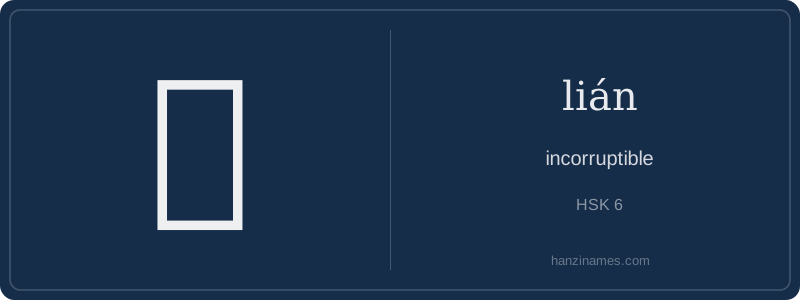
廉 appears ubiquitously in official discourse, media, and education: ‘廉洁自律’ (self-discipline and integrity) is a mandatory phrase in CCP cadre training; ‘廉政建设’ (integrity-building initiatives) is a formal policy domain since the 1990s. The idiom ‘廉潔奉公’ (upright, selfless, and devoted to public service) dates to Ming dynasty administrative manuals and remains in civil service oaths. State media reports on disciplinary cases routinely use ‘廉’ in headlines (e.g., ‘某官员丧失廉洁底线’—‘An official lost his integrity baseline’).
The character’s form evolved from seal script, where 广 (a roof radical) frames 兼 (‘to hold two things at once’), suggesting restraint—holding power without grasping wealth. Though not pictographic, this structure was standardized by the Han dynasty and appears unchanged in the Kangxi Dictionary (1716). Today, Chinese citizens encounter 廉 daily on subway posters promoting ‘廉洁文化’ (integrity culture) and in school textbooks teaching Confucian virtues.
廉 (lián) is far more than a lexical entry—it embodies a cornerstone of Confucian political ethics and Chinese civilizational self-understanding. Rooted in the idea of 'unadorned integrity,' 廉 originally evoked the clean, unblemished edge of a knife or jade—something sharp, pure, and free from excess. In classical thought, it described not just absence of corruption, but the active virtue of modesty, frugality, and moral clarity that enables fair governance.
This character reflects a worldview where personal virtue and public duty are inseparable: one cannot govern justly without first governing oneself. Unlike Western legalistic anti-corruption frameworks, 廉 integrates ethics, aesthetics (e.g., plain clothing, simple dwellings), and accountability into a holistic standard for officials—seen in imperial examinations that tested moral discernment alongside literary skill.
Even today, 廉 anchors China’s modern anti-graft discourse—not as a foreign import, but as cultural continuity. Its presence in slogans like ‘廉洁政府’ (a clean government) signals legitimacy rooted in millennia-old expectations. To call someone 廉 is to affirm their moral geometry: aligned, unyielding, and transparent—like light passing straight through unstained glass.
Example Sentences
Common Compounds
Similar Characters — Don't Mix These Up
Your First Step into Chinese Culture: Get a Chinese Name
Every journey into Chinese begins with a name. Use our free Chinese name generator to create a meaningful, personalized Chinese name that fits you perfectly.
Get My Chinese Name →