御
Character Story & Explanation
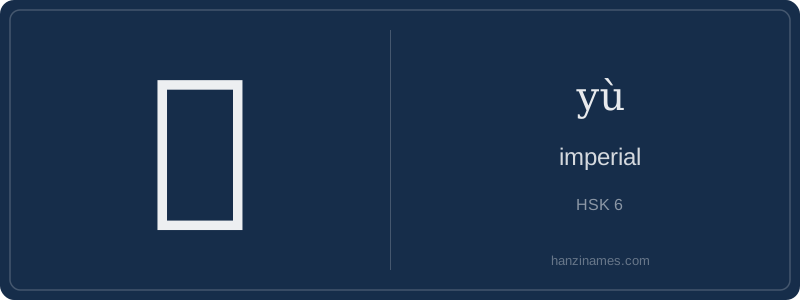
Historically, 御 appears frequently in official titles and documents from the Qin and Han dynasties onward—for example, 御史 (yùshǐ, Imperial Censor), a key surveillance office established under Qin Shi Huang. It remains in modern formal compounds like 御用 (yùyòng, ‘imperial use’ → ‘state-sanctioned’ or ‘officially designated’), often used ironically in media to describe government-approved experts or institutions. The idiom 御驾亲征 (yùjià qīnzhēng, ‘the emperor personally leads the expedition’) is still cited in historical discourse and news analysis to underscore decisive top-level action.
The character’s seal script form shows a person (radical 彳) beside a chariot (original component 與, later simplified to 卸), reflecting its earliest documented meaning: ‘to drive the imperial chariot’. This concrete origin—as a verb of skilled, authoritative motion—is well attested in bronze inscriptions and the Shuōwén Jiězì (100 CE), confirming its link to ritualized mobility and sovereign agency.
The character 御 (yù) embodies the Confucian-anchored worldview where authority is not merely political but cosmological—tied to the Mandate of Heaven. Its radical 彳 (‘step’) signals movement, governance, and ritual procession, while the right side 卸 (originally meaning ‘to unload’ or ‘to harness’) evolved phonetically and semantically to denote controlled command—especially over imperial chariots, horses, and, by extension, state affairs. This reflects how Chinese thought links physical mastery (e.g., driving a royal carriage) with moral stewardship.
In classical usage, 御 never stood alone as ‘royal’ in isolation; it always implied active, virtuous exercise of power—‘to govern’, ‘to preside over’, or ‘to ward off’. Unlike Western notions of sovereignty rooted in law or divine right, 御 suggests embodied, performative legitimacy: the emperor *does* royalty through ritual, restraint, and responsiveness to heaven’s signs. Thus, the character encodes a dynamic ideal: authority as disciplined service, not static privilege.
Even today, 御 carries an aura of refined control—whether in martial arts (御气 ‘to guide one’s qi’), tea ceremony (御前 ‘imperial presence’), or cybersecurity (御用 software ‘officially sanctioned’). Its persistence reveals how deeply Chinese culture values *competence in constraint*: true power lies not in force, but in calibrated, ceremonial, and ethically grounded direction. To ‘use’ 御 is to invoke a legacy where leadership is measured by harmony—not dominance.
Example Sentences
Common Compounds
Similar Characters — Don't Mix These Up
Your First Step into Chinese Culture: Get a Chinese Name
Every journey into Chinese begins with a name. Use our free Chinese name generator to create a meaningful, personalized Chinese name that fits you perfectly.
Get My Chinese Name →