怠
Character Story & Explanation
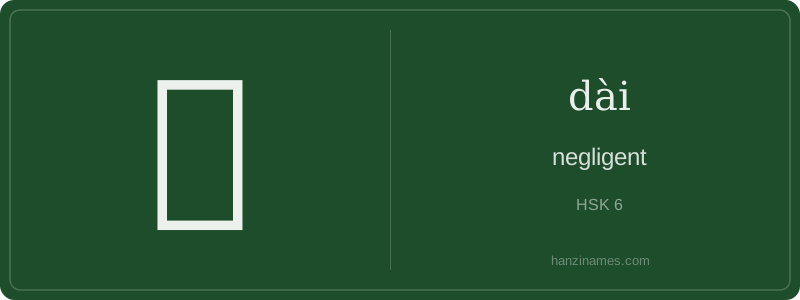
怠 appears in formal, often critical contexts: classical texts, official documents, and modern bureaucratic discourse. It’s central to the idiom 怠慢 (dài màn, 'to treat with negligence or disrespect'), famously used in the Ming novel *Jin Ping Mei* to describe social slights among elites. In contemporary usage, it frequently occurs in phrases like ‘怠工’ (dài gōng, 'work-to-rule' or passive resistance) and ‘怠政’ (dài zhèng, 'dereliction of duty'), widely cited in Chinese media when critiquing administrative inefficiency.
The character evolved from seal script (c. 3rd c. BCE), where its structure already combined 心 (heart/mind) with 台 as a phonetic component. No oracle bone form survives—its earliest attestation is in Warring States bamboo manuscripts. Today, Chinese speakers use 怠 most commonly in compound words expressing moral or institutional failure—not casual idleness—but rather a systemic, culpable slackness.
As an archaeologist brushing dust from a Han dynasty bamboo slip, I find 怠 inscribed in clerical script—its 心 (heart/mind) radical unmistakably anchoring the character’s semantic core. The upper component, 台 (tái), functions phonetically but also evokes 'platform' or 'base', suggesting a mind resting *on* something rather than actively engaging—a subtle, ancient diagnosis of mental inertia.
This character wasn’t carved for farmers or laborers; it appears in imperial edicts and Confucian commentaries like the *Book of Rites*, where ‘怠政’ (dài zhèng)—‘idle governance’—condemns officials who neglect duty. Its nine strokes encode moral gravity: not mere laziness, but a failure of *xin* (heart-mind), the ethical center in classical Chinese thought.
Excavating further into Song-era Neo-Confucian texts, 怠 gains philosophical weight—it’s the antonym of 敬 (jìng, ‘reverent diligence’). Zhu Xi warned that 怠 arises not from fatigue, but from *waning moral vigilance*. Thus, 怠 is less ‘idle’ in the English sense and more ‘spiritually unmoored’—a psychological state with political consequences, preserved across millennia in ink and bamboo.
Example Sentences
Common Compounds
Similar Characters — Don't Mix These Up
Your First Step into Chinese Culture: Get a Chinese Name
Every journey into Chinese begins with a name. Use our free Chinese name generator to create a meaningful, personalized Chinese name that fits you perfectly.
Get My Chinese Name →