惑
Character Story & Explanation
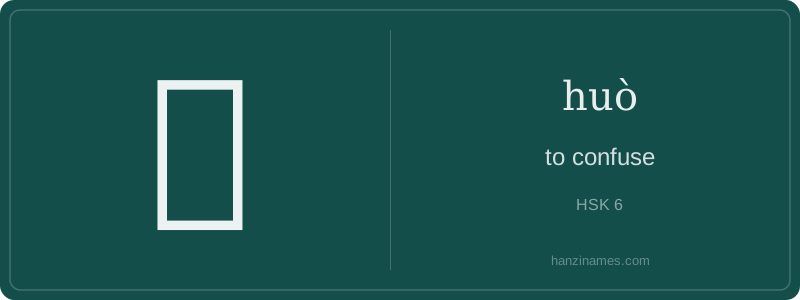
In modern Mandarin, 惑 appears most frequently in formal, literary, or psychological contexts—not in casual speech. It’s central to the idiom 惑而不解 (huò ér bù jiě), meaning 'perplexed yet unable to resolve', cited in educational discourse about critical thinking. Historically, Confucius used 惑 in the *Analects* (2.18) to describe the danger of studying without reflection: 學而不思則罔,思而不學則惑 ('Learning without thought is labor lost; thought without learning is perilous confusion').
The character’s form evolved from seal script: the left side 心 (heart/mind) is unambiguous; the right side 或 is a phonetic loan originally meaning 'region' or 'perhaps', later repurposed for sound. No oracle-bone form survives—its earliest attestation is in Warring States bamboo manuscripts, confirming its late emergence as a specialized term for intellectual uncertainty.
As an archaeologist brushing dust from a Han dynasty bamboo slip, I find 惑 inscribed in elegant clerical script—not as a pictorial glyph, but as a carefully composed semantic-phonetic compound. Its heart radical (心) anchors it firmly in the realm of inner experience, while the phonetic component (或) hints at sound but also carries ancient connotations of 'boundary' or 'uncertainty', suggesting mental terrain without clear contours.
Excavating deeper into Warring States texts like the *Guodian Chu Slips*, 惑 appears not merely as passive confusion, but as a moral and epistemological rupture—when ritual propriety (li) falters or when sage counsel is ignored. It’s never trivial bewilderment; it’s the dangerous fog that precedes ethical misstep, recorded by scribes who treated cognition as archaeologically significant strata.
Unlike modern assumptions of ‘confusion’ as cognitive overload, classical usage treats 惑 as an active, relational failure: one is *made* to doubt by deceptive rhetoric (e.g., Mencius condemning sophistry), or *falls into* doubt through self-deception. The 12 strokes map a psychological excavation—each stroke a layer revealing how ancient thinkers diagnosed the mind’s vulnerability to illusion, not error.
Example Sentences
Common Compounds
Similar Characters — Don't Mix These Up
Your First Step into Chinese Culture: Get a Chinese Name
Every journey into Chinese begins with a name. Use our free Chinese name generator to create a meaningful, personalized Chinese name that fits you perfectly.
Get My Chinese Name →