惦
Character Story & Explanation
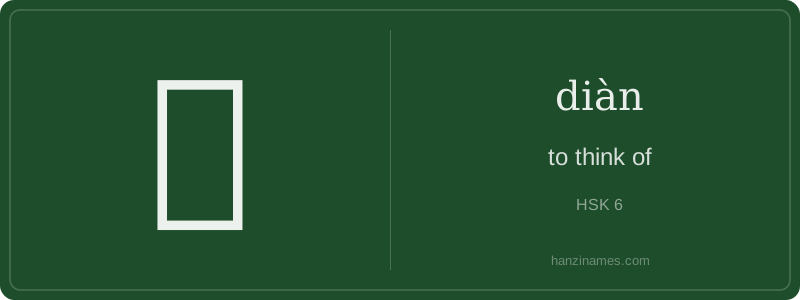
惦 is commonly used in spoken and written Mandarin to express heartfelt, ongoing concern—especially by parents, spouses, or elders. It appears in fixed phrases like '惦记着' (diàn jì zhe, 'thinking of [someone] constantly') and is frequent in modern literature (e.g., Ba Jin’s family novels) and CCTV public service announcements on filial duty. Though rare in isolation, it’s indispensable in conveying emotional continuity across distance or time.
The character combines the heart radical 忄 (indicating emotion or mental state) with 店 (diàn, 'shop'), which serves phonetically. Historically, it emerged during the late imperial period as a semantic-phonetic compound; no oracle-bone or bronze script forms exist. Its written form reflects standard phono-semantic construction—not pictographic origin—but its usage has remained remarkably stable since the early 20th century.
The Chinese character 惦 (diàn) conveys a gentle, persistent, emotionally tinged form of thinking—less about intellectual recall and more about tender, often anxious or affectionate preoccupation. Unlike English 'think of', which can be neutral or fleeting, 惦 implies warmth, care, and quiet mental lingering, typically toward people (loved ones, elders, absent friends) rather than abstract concepts. It’s deeply relational and embedded in familial and social ethics.
This nuance aligns closely with Confucian ideals of *ren* (benevolence) and *xiao* (filial piety), where sustained emotional attention reflects moral commitment. In contrast, Western equivalents like 'to miss' emphasize absence and longing, while 'to worry about' carries negative connotations of anxiety—neither fully captures 惦’s blend of tenderness, responsibility, and unspoken devotion.
Culturally, 惦 is rarely used in formal writing or official speech but thrives in intimate registers: letters, diaries, parental admonitions, and literary dialogue. Its presence signals emotional authenticity—not dramatic passion, but the quiet hum of ongoing care. That subtlety makes it uniquely challenging for learners: mastering 惦 means grasping not just vocabulary, but the Chinese cultural grammar of unvoiced love and dutiful remembrance.
Example Sentences
Common Compounds
Similar Characters — Don't Mix These Up
Your First Step into Chinese Culture: Get a Chinese Name
Every journey into Chinese begins with a name. Use our free Chinese name generator to create a meaningful, personalized Chinese name that fits you perfectly.
Get My Chinese Name →