外
Character Story & Explanation
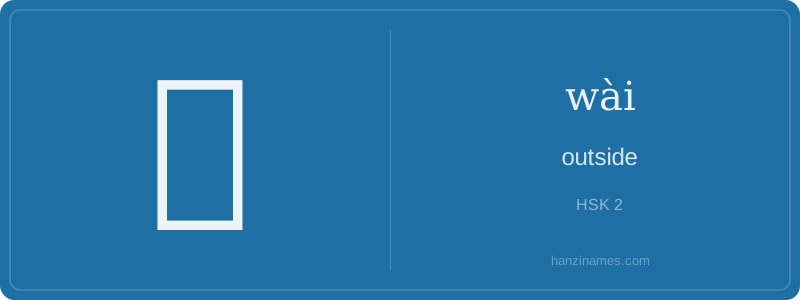
In modern China, 外 is ubiquitous on street signs (e.g., 外门 'external gate'), government documents (e.g., 外交部 Ministry of Foreign Affairs), and everyday speech. It’s central to HSK 2 vocabulary and appears in key phrases like 以外 ('beyond'), 外面 ('outside'), and 外地 ('another region'). The idiom 里应外合 (lǐ yìng wài hé, 'internal-external coordination')—documented since the Ming dynasty—refers to coordinated attacks from inside and outside, illustrating its enduring strategic use.
The character’s earliest verified form (late Shang/early Zhou bronze script) shows 夕 (sunset) above (a simplified person), likely indicating 'the person beyond the settlement at dusk'—a documented spatial and temporal marker of boundary awareness in early Chinese urban planning and defense texts.
The character 外 (wài) vividly captures the idea of 'outside'—not just physically beyond a boundary, but conceptually beyond a norm, group, or origin. In daily life, it appears everywhere: on signs marking 'external entrances', in news headlines about 'foreign affairs' (外交), and even in casual speech like '外边冷' ('It’s cold outside'). Its simplicity—just five strokes—belies its semantic weight, anchoring spatial, social, and geopolitical distinctions in Chinese thought.
Historically, 外 emerged in bronze inscriptions during the Western Zhou dynasty (c. 1046–771 BCE) as a compound of 夕 (xī, 'sunset' or 'evening') and (a variant of 人, 'person'), suggesting a person standing beyond the settlement at dusk—a time when outsiders were traditionally watched for safety. This reflects ancient China’s strong distinction between 'inside' (内, nèi) — family, state, civilization — and 'outside' — wilderness, foreigners, or threats.
Today, 外 remains deeply embedded in identity and policy. Phrases like 外国人 (wàiguó rén, 'foreigner') and 外语 (wàiyǔ, 'foreign language') carry neutral or positive connotations, while terms like 外行 (wàiháng, 'layperson') imply respectful acknowledgment of expertise boundaries. Even tech culture adopts it: 外挂 (wàiguà, 'external cheat software') literally means 'external attachment'—a direct extension of the character’s core meaning into digital life.
Example Sentences
Common Compounds
Similar Characters — Don't Mix These Up
Your First Step into Chinese Culture: Get a Chinese Name
Every journey into Chinese begins with a name. Use our free Chinese name generator to create a meaningful, personalized Chinese name that fits you perfectly.
Get My Chinese Name →