惹
Character Story & Explanation
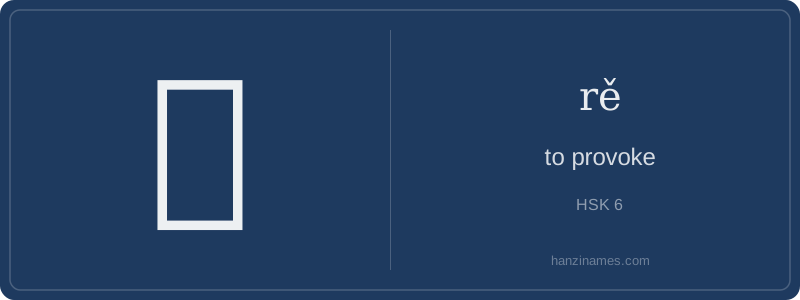
惹 is widely used in modern Mandarin to express unintentional or careless provocation—especially in phrases like 惹麻烦 (rě máfan, 'to cause trouble') and 惹人讨厌 (rě rén tǎoyàn, 'to annoy people'). It appears in official warnings (e.g., '请勿惹怒动物' — 'Do not provoke animals'), legal documents (e.g., 惹起公愤, 'to incite public outrage'), and everyday expressions like 惹火 (rě huǒ, 'to enrage'). A well-documented idiom is 惹是生非 (rě shì shēng fēi), meaning 'to stir up trouble', recorded in Ming-Qing vernacular fiction and still used in media today.
The character’s earliest attested form appears in the Shuōwén Jiězì (c. 100 CE) as a phono-semantic compound: the top component 若 (ruò, 'if, like') provides sound, while 心 ('heart') conveys meaning—indicating emotional impact rather than physical action. No oracle-bone or bronze inscriptions of 惹 survive; its structure reflects Han dynasty standardization, not pictographic origins.
The character 惹 (rě) embodies a subtle yet profound aspect of Chinese relational ethics: the idea that provocation is rarely accidental—it arises from an interplay of intention, perception, and emotional resonance. Rooted in the 心 (xīn, 'heart/mind') radical, it signals that provoking isn’t merely external action but an internal stirring—what one *stirs up* in another’s heart. This reflects the Confucian- and Daoist-influenced worldview where human interactions are seen as dynamic fields of qi (vital energy), where even silence or a glance can ‘set something in motion’.
In classical Chinese thought, cause and effect are seldom linear; 惹 captures this non-mechanical causality—like dropping a pebble into still water, the ripple isn’t ‘caused’ by force alone but by context, depth, and sensitivity. Thus, to 惹 trouble isn’t just to initiate conflict, but to disturb harmony (和, hé), a core cultural value. The character implies moral accountability not only for what one does, but for what one *awakens* in others.
This sensibility permeates Chinese literature, law, and daily etiquette. For example, in traditional dispute resolution, mediators often ask not ‘Who struck first?’ but ‘What led someone to feel provoked?’—highlighting that the ‘provoker’ may bear responsibility even without overt aggression. 惹 thus encodes a worldview where emotional ecology matters more than binary blame, urging mindfulness in speech, tone, and presence. It’s a linguistic reminder: in human relationships, every action is also an invitation—to resonance or rupture.
Example Sentences
Common Compounds
Similar Characters — Don't Mix These Up
Your First Step into Chinese Culture: Get a Chinese Name
Every journey into Chinese begins with a name. Use our free Chinese name generator to create a meaningful, personalized Chinese name that fits you perfectly.
Get My Chinese Name →