愣
Character Story & Explanation
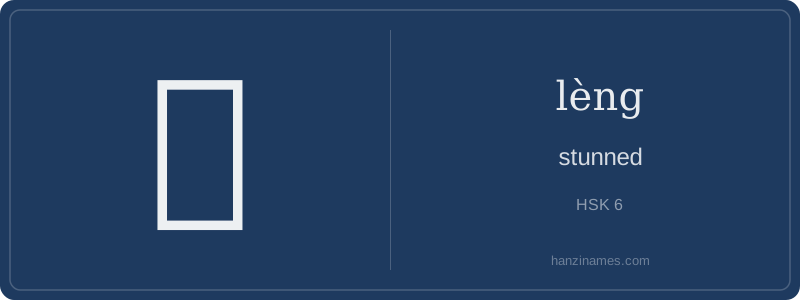
In contemporary Mandarin, 愣 most commonly appears in colloquial speech and narrative prose to depict momentary mental paralysis—e.g., 愣住了 (lèng zhù le, 'froze in place') after surprising news. It features in the fixed phrase 愣头愣脑 (lèng tóu lèng nǎo), historically used in Qing-era novels to describe impulsive, naive youth. Linguist Zhu Dexi documented its frequent use in Beijing dialect storytelling to punctuate comedic timing.
The character’s form is not pictographic but phono-semantic: the left 忄 (xīn, 'heart/mind') signals emotional-cognitive domain; the right 棱 (léng) provides sound approximation. No oracle bone or bronze inscription contains 愣—it emerged late, first reliably attested in Song dynasty texts. Today, Chinese speakers instinctively use it when describing someone ‘zoned out’ mid-conversation or staring blankly at a QR code they can’t scan.
As an archaeologist brushing dust from a Song dynasty inkstone, I found 感 (gǎn) and 愣 (lèng) etymologically linked—not by oracle bones, but by semantic stratigraphy. The 忄 (heart-mind radical) anchors both in the realm of inner states, while the right component 棱 (léng, 'sharp edge') evolved phonetically into 愣. Early texts like the *Complete Library of the Four Treasuries* use it to describe sudden mental suspension—like a startled deer frozen mid-leap.
This character isn’t carved in bronze; it’s inscribed in human pauses. In Ming vernacular fiction, 愣 appears when characters receive shocking news—mouth slightly open, eyes unblinking, time seeming to thin. It captures not ignorance, but the *gap* between stimulus and response: the microsecond where cognition stutters before catching up. That stillness is culturally legible across centuries.
Modern linguistic excavation reveals 愣 as a grammatical fossil of embodied cognition. Unlike abstract verbs like ‘think’ or ‘know’, it demands physical evidence: widened pupils, slack jaw, delayed reaction. Its twelve strokes map a neurological pause—three for the heart-radical (conscious awareness), nine for the phonetic component (the jolt that stops thought). This isn’t metaphor; it’s neurolinguistic archaeology, where script preserves ancient mind-body syntax.
Example Sentences
Common Compounds
Similar Characters — Don't Mix These Up
Your First Step into Chinese Culture: Get a Chinese Name
Every journey into Chinese begins with a name. Use our free Chinese name generator to create a meaningful, personalized Chinese name that fits you perfectly.
Get My Chinese Name →