忧
Character Story & Explanation
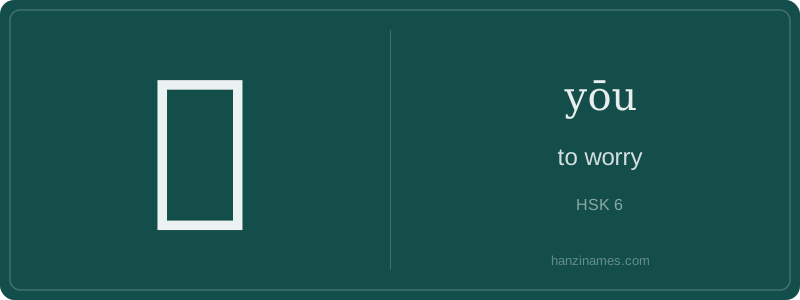
In modern usage, 忧 appears most frequently in formal, literary, or emotionally elevated contexts: news headlines about national concerns (民生之忧), classical poetry (e.g., Du Fu’s ‘感时花溅泪,恨别鸟惊心’), and idioms like 忧国忧民 (yōu guó yōu mín, 'to worry about one’s country and people'). It rarely occurs in casual speech—native speakers prefer 担心 (dānxīn) for everyday worry. Historically, the Shuowen Jiezi (100 CE) defines it as ‘愁也’ (chóu yě, 'sorrow'), confirming its ancient association with deep, sustained emotional weight rather than fleeting anxiety.
The written form evolved from bronze inscriptions where the heart radical was explicit and 尤 resembled a figure with exaggerated limbs—symbolizing ‘exceptional condition’. By the Han dynasty, standardized clerical script fixed the 7-stroke structure we use today: three dots (忄) + four strokes (尤), reflecting phonetic simplification and semantic consolidation.
As an archaeologist brushing dust from a Han dynasty bamboo slip, I find 忧 etched not as a static glyph but as a living tremor in the heart-mind. Its left radical 忄—'heart'—anchors it in visceral emotion, while the right component 尤 (yóu) originally denoted 'outstanding defect' or 'notable flaw' in early seal script. This pairing suggests worry arises not from mere fear, but from acute awareness of something fundamentally amiss—a cognitive-emotional rupture documented in medical texts like the Huangdi Neijing, where 忧 is linked to spleen qi disruption.
The character’s seven-stroke form crystallized during the Qin standardization, shedding earlier variants with more elaborate 'heart' components. Unlike pictographic characters such as 日 (sun), 忧 is semantic-phonetic: 忄 signals emotional domain, 尤 provides both sound (approx. yōu) and conceptual weight—implying worry is *focused concern about a specific anomaly*. Excavated Mawangdui manuscripts (2nd c. BCE) use 忧 consistently in contexts of grief, political anxiety, and moral unease—not vague anxiety, but targeted distress rooted in observable imbalance.
This precision persists today: 忧 never means casual stress (that’s 紧张 or 压力), nor clinical anxiety (焦虑). It conveys solemn, often morally or existentially charged concern—like Confucius’ lament in the Analects (7.3): ‘不愤不启,不悱不发,举一隅不以三隅反,则不复也’—where pedagogical frustration borders on 忧. The character’s archaeological layering reveals Chinese thought treating worry not as pathology, but as a sign of ethical attentiveness—a diagnostic signal that reality has deviated from its proper order.
Example Sentences
Common Compounds
Similar Characters — Don't Mix These Up
Your First Step into Chinese Culture: Get a Chinese Name
Every journey into Chinese begins with a name. Use our free Chinese name generator to create a meaningful, personalized Chinese name that fits you perfectly.
Get My Chinese Name →