愤
Character Story & Explanation
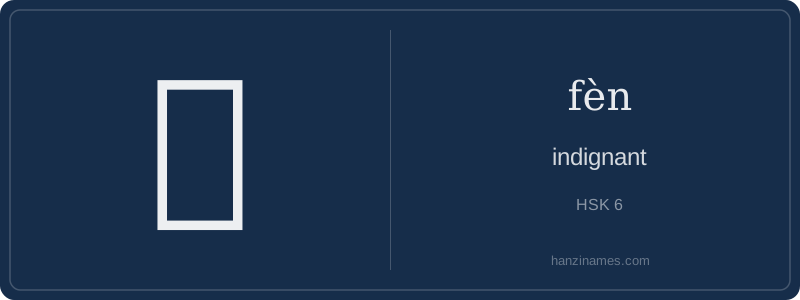
In contemporary Chinese, 愤 frequently appears in compound words like 愤怒 (fènnù, 'anger') and 愤世嫉俗 (fènshì-jísú, 'indignant toward worldly corruption'), a phrase dating back to Song dynasty scholar Lu You’s poetry. It’s central to modern political and social commentary—e.g., the term 愤青 (fènqīng, 'angry youth') emerged online in the early 2000s to describe nationalist, socially critical young netizens. Official media and academic texts use 愤 to denote justified moral outrage, distinguishing it from volatile or illegitimate anger.
The character is not pictographic—it has no oracle-bone or bronze inscription origin. Its structure is phono-semantic: 忄 conveys emotion, while 分 (fēn) serves both phonetic (fèn shares historical sound links with fēn) and semantic roles ('division' reflecting psychological tension). In daily life, Chinese learners encounter it most in HSK 6 reading passages on ethics, media literacy, or civic discourse—never in greetings or casual chat, underscoring its formal, reflective weight.
As a linguistic detective, I begin at the scene: the character 愤. Its left radical 忄—'heart-mind'—immediately signals an internal emotional state, not external action. This isn’t mere anger; it’s the kind that simmers beneath reason, rooted in perceived injustice. The right component 分 (fēn), meaning 'to divide' or 'to separate', adds conceptual tension: a mind torn by moral contradiction, split between restraint and outrage. Together, they encode a cognitive-emotional rupture—not raw rage, but indignation as a reasoned verdict of the heart.
Historically, 愤 appears early in classical texts like the *Analects* (e.g., 《论语·述而》: '不愤不启'), where Confucius uses it to describe the mental state just before intellectual breakthrough—a frustration born of sincere effort to grasp truth. This reveals its semantic depth: 愤 is not irrational fury, but the productive, almost pedagogical discomfort of confronting unfairness or incomprehension. It’s emotion with ethical weight, demanding resolution through reflection or action.
The character’s evolution reflects tightening semantic focus. While earlier forms (Warring States bamboo slips) show variant structures, the standardized Qin–Han script crystallized 忄+分 as the norm—reinforcing its association with morally charged inner tension. Unlike 怒 (nù, 'anger') or 恨 (hèn, 'hatred'), 愤 resists impulsive expression; it’s often silent, simmering, and socially contextualized. Modern usage preserves this nuance: it appears in formal writing, political discourse, and literary critique—not casual outbursts—but always tied to legitimacy, fairness, and conscience.
Example Sentences
Common Compounds
Similar Characters — Don't Mix These Up
Your First Step into Chinese Culture: Get a Chinese Name
Every journey into Chinese begins with a name. Use our free Chinese name generator to create a meaningful, personalized Chinese name that fits you perfectly.
Get My Chinese Name →