惩
Character Story & Explanation
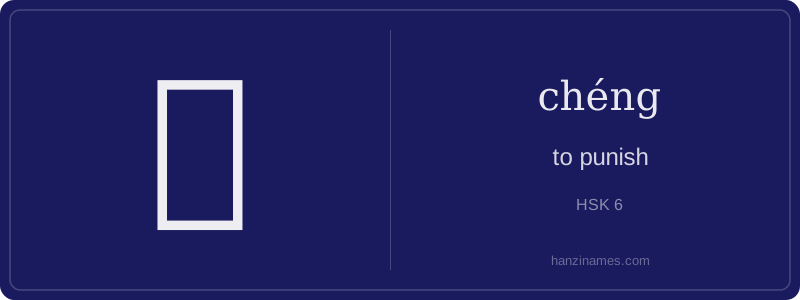
In contemporary Chinese legal, educational, and media contexts, 惩 appears in formal, authoritative registers—never in casual speech. It’s central to phrases like 惩前毖后 (chéng qián bì hòu, 'learn from past mistakes to avoid future ones'), a CCP political slogan since 1942, and appears in the PRC Criminal Law (Article 5) mandating 'punishment commensurate with crime' (罪刑相适应原则). News headlines use it for official disciplinary actions: e.g., '严肃惩处违纪干部' ('strictly punish discipline-violating officials').
The character evolved from seal script (c. 3rd c. BCE), where it combined 征 (military campaign) over 心 (heart/mind). Unlike pictographic characters (e.g., 日 'sun'), 惩 is phono-semantic: 征 provides both sound and martial connotation, while 心 specifies the domain—moral cognition. No oracle bone form exists; its earliest attestation is late Warring States bamboo slips from Guodian (c. 300 BCE).
As an archaeologist sifting through layers of linguistic sediment, I uncover 惩 not as a blunt instrument of retribution, but as a carefully calibrated moral mechanism—its heart radical (心) revealing that ancient Chinese jurists viewed punishment not as mere physical correction, but as an internal, conscience-engaged act of restoration. The top component, 征 (zhēng), originally meant 'to march forth to subdue'—a military campaign turned inward, signifying the disciplined enforcement of ethical order.
This character first appears reliably in Warring States bamboo texts and early Han legal manuscripts, where it consistently denotes state-administered corrective action—not vengeance, but measured consequence aligned with ritual propriety (lǐ) and virtue (dé). Its 12-stroke structure reflects deliberate balance: three strokes for the ‘heart’ base anchoring six for the ‘marching’ top, symbolizing intentionality before action—a forensic detail confirming its philosophical gravity.
Unlike punitive characters rooted in force (e.g., 罰 fá), 惩 carries an implicit pedagogical weight: to punish *in order to correct*. Excavated Qin dynasty legal codes (e.g., Shuihudi texts) show magistrates using 惩 specifically for rehabilitative sanctions—reassigning corrupt clerks rather than executing them. This semantic nuance survived millennia, making 惩 uniquely resonant in modern Chinese legal discourse, where ‘punishment’ is constitutionally tied to ‘education and reform’ (教育与改造).
Example Sentences
Common Compounds
Similar Characters — Don't Mix These Up
Your First Step into Chinese Culture: Get a Chinese Name
Every journey into Chinese begins with a name. Use our free Chinese name generator to create a meaningful, personalized Chinese name that fits you perfectly.
Get My Chinese Name →