截
Character Story & Explanation
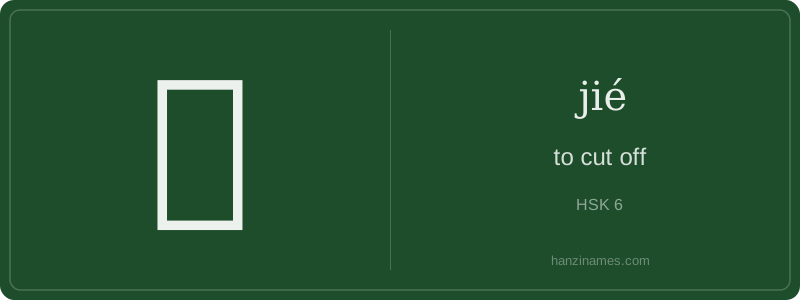
In daily life, 截 is ubiquitous in official and digital contexts: government notices say ‘报名截止日期’ (bàomíng jiézhǐ rìqī, 'registration deadline'), subway announcements warn ‘列车已截停’ (lièchē yǐ jié tíng, 'train has been halted'), and WeChat displays ‘消息已截屏’ (xiāoxi yǐ jiépíng, 'message screenshot taken'). It appears in six standard HSK 6 vocabulary items and over 20 idioms—including the classical phrase ‘截然不同’ (jiérán bùtóng, 'completely different'), documented since the Song dynasty in Zhu Xi’s commentaries.
The character’s form shows 戈 (dagger-axe) on the left, reflecting its ancient association with decisive action; the right side is 裁 (cái), meaning 'to cut cloth'—a documented phonosemantic compound from the Qin bamboo slips (c. 3rd century BCE), where it consistently meant 'to halt or terminate' in administrative texts. No oracle bone form survives, but early seal script confirms this structure.
The character 截 (jié) evokes the sharp, decisive motion of cutting—like a surgeon’s scalpel severing tissue or a railway worker halting a train with a hand signal. Its radical 戈 (gē), meaning 'dagger-axe,' anchors it in ancient warfare imagery: not brute force, but precise, authoritative interruption. This sense of controlled termination permeates modern usage—from digital interfaces to legal documents—making 截 less about violence and more about boundary-setting and timing.
Though written with 14 strokes, its structure is logical: the left side 戈 provides the ‘cutting’ semantic hint, while the right side 裁 (cái, 'to cut cloth') reinforces the core idea of deliberate division. Learners often misread the top-right component as ‘clothing’ (衣), but it’s actually 裁—emphasizing intentionality, not accident. This duality—martial radical + textile verb—reflects how Chinese characters layer historical function with everyday precision.
At HSK Level 6, 截 signals advanced fluency because it appears in abstract, high-register contexts: deadline enforcement (截止), data truncation (截断), or rhetorical interruption (截住话头). Unlike simpler synonyms like 切 (qiē, 'to slice'), 截 implies finality and external agency—something is *cut off* by an authority or system, not merely divided. Mastering it unlocks nuance in bureaucratic, technical, and literary Chinese, where timing and control are linguistically encoded.
Example Sentences
Common Compounds
Similar Characters — Don't Mix These Up
Your First Step into Chinese Culture: Get a Chinese Name
Every journey into Chinese begins with a name. Use our free Chinese name generator to create a meaningful, personalized Chinese name that fits you perfectly.
Get My Chinese Name →