扎
Character Story & Explanation
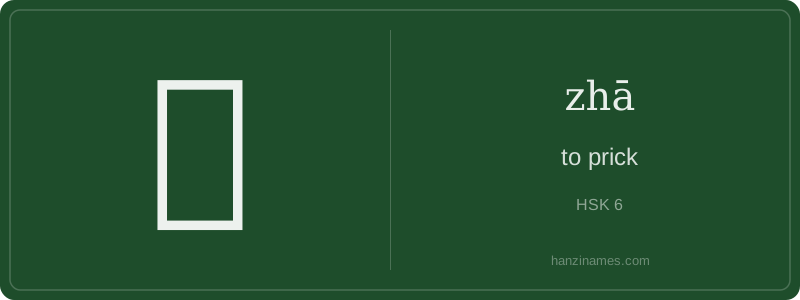
扎 appears in daily life far beyond medical contexts: nurses say 扎针 (zhā zhēn, 'to give an injection'), children learn 扎风筝 (zā fēngzheng, 'to assemble a kite frame'), and chefs use 扎花刀 (zhā huādāo, 'to score fish with crisscross cuts'). Historically, 扎 entered military lexicons during the Ming dynasty as 扎营 (zhā yíng, 'to set up camp'), evoking troops driving stakes into ground — a documented usage in 16th-century military manuals like the Ji Xiao Xin Shu.
The character’s form has no oracle-bone or bronze inscription record. Its earliest attested shape appears in clerical script (c. 200 BCE–200 CE), already with 扌 + 乚 — suggesting it emerged as a phonosemantic character during bureaucratic standardization, not ancient pictography. Today, millions type 扎 daily on smartphones when booking vaccine appointments — a digital echo of its enduring association with precise, penetrating action.
Our detective begins at the crime scene: the character 扎. With just four strokes and the hand radical 扌, it signals an action performed by the hand — not a passive object, but an intentional, physical act. The top component ‘札’ (originally meaning 'wooden slip') was simplified over centuries into ‘乚’ + ‘一’, but its phonetic role remains faintly traceable in older pronunciations. This isn’t a pictograph of a needle; it’s a semantic-phonetic compound born from administrative writing tools repurposed for bodily sensation.
Zooming in on pronunciation: zhā (HSK 6) dominates modern usage — ‘to prick’, ‘to stab’, ‘to inject’. But zā persists in fixed compounds like 扎辫子 (zā biànzi, 'to braid hair'), where the meaning shifts to ‘to tie tightly’, revealing how phonetic borrowing preserved archaic verb senses. This duality isn’t inconsistency — it’s linguistic stratification, like finding Victorian slang surviving in a barbershop chant.
The radical 扌 (hand) anchors all meanings in manual agency: whether piercing skin with a needle (zhā) or securing hair with a ribbon (zā), the hand initiates forceful, localized contact. Even in metaphorical extensions — like 扎根 (zhāgēn, 'to take root') — the imagery remains tactile: roots *prick* into soil, anchoring like tiny stakes. This coherence across millennia shows how Chinese characters encode embodied cognition — not just what is done, but *how the body does it*.
Example Sentences
Common Compounds
Similar Characters — Don't Mix These Up
Your First Step into Chinese Culture: Get a Chinese Name
Every journey into Chinese begins with a name. Use our free Chinese name generator to create a meaningful, personalized Chinese name that fits you perfectly.
Get My Chinese Name →