事
Character Story & Explanation
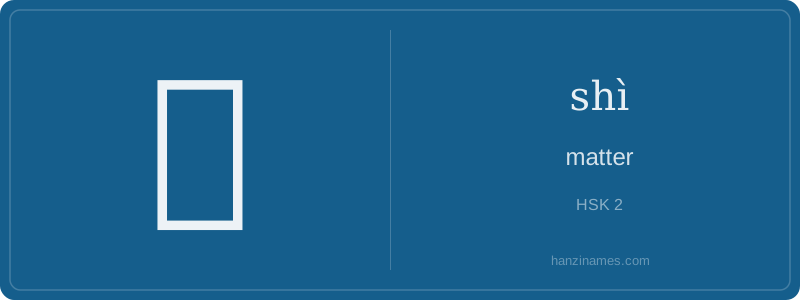
事 appears constantly in modern Chinese life: in office emails (‘Please handle this matter promptly’ → 请尽快处理此事), public notices (‘Safety matters first’ → 安全第一), and everyday expressions like 没事 (méishì, 'It’s nothing') or 出事 (chūshì, 'an incident occurred'). It’s central to idioms such as 无事不登三宝殿 (wúshì bù dēng sānbǎodiàn, 'No one visits the temple without purpose'), illustrating its deep cultural link to intentionality and cause. Historically, 事 was already standard in classical texts like the Analects, where Confucius discusses 'affairs of state' and 'personal conduct matters'.
The modern form of 事 derives from seal script, where it combined 亅 (a hook suggesting 'involvement') and 史 (shǐ, 'historian' or 'record')—reflecting its original sense of 'recorded affairs'. While oracle-bone origins are debated, by the Warring States period (475–221 BCE), 事 consistently meant 'matter' or 'duty' in inscriptions and bamboo-slip manuscripts.
Hi students! The character 事 (shì) is a foundational word in Chinese—it means 'matter', 'affair', or 'thing' in a broad, abstract sense. Unlike concrete nouns like 'book' or 'chair', 事 refers to events, tasks, situations, or issues—anything that happens or needs attention. It’s one of the most frequently used characters in daily speech and writing, appearing in greetings ('How are things?'), formal documents, and even slang. Mastering 事 helps you understand not just vocabulary, but how Chinese speakers frame experiences as 'matters' to be handled, discussed, or resolved.
This character belongs to HSK Level 2, meaning it’s essential for early conversational fluency. Though it looks simple (only 8 strokes), its versatility makes it powerful: it can stand alone ('No problem!' → 没事!), combine into compound nouns ('business', 'event'), or appear in grammatical structures like 'to do something' (做事). Pay attention to tone—it’s fourth tone (shì), falling sharply, like a firm 'shih!'—not to be confused with shī (teacher) or shí (ten).
Notice the radical 亅 (jué), a hook-like stroke often associated with action or involvement—fitting, since 事 implies something active or requiring engagement. The remaining components (‘one’ + ‘history’-like top) evolved from ancient forms representing 'recorded events', reflecting how early Chinese saw 'matters' as documented occurrences. Don’t worry about memorizing the old forms—just remember: 事 = anything that *happens* or *needs doing*. With practice, you’ll spot it everywhere—from text messages to news headlines!
Example Sentences
Common Compounds
Similar Characters — Don't Mix These Up
Your First Step into Chinese Culture: Get a Chinese Name
Every journey into Chinese begins with a name. Use our free Chinese name generator to create a meaningful, personalized Chinese name that fits you perfectly.
Get My Chinese Name →