抑
Character Story & Explanation
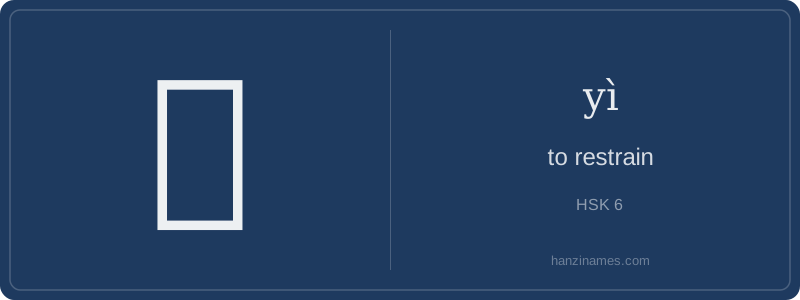
In modern Chinese, 抑 appears most frequently in formal and literary contexts—not daily chatter, but essays, editorials, and classical allusions. It’s indispensable in the idiom 抑扬顿挫 (yì yáng dùn cuò), describing the rhythmic rise-and-fall of eloquent speech or music, where 抑 signifies the deliberate lowering or softening of tone. Historically, it appears in the Book of Rites (c. 3rd century BCE) advising rulers to 'restrain extravagance' (抑奢), cementing its role in governance and self-discipline.
The character’s form is not pictographic but phono-semantic: 扌 (hand radical) signals meaning related to action; the right component 昜 (yáng, archaic variant of 陽) originally suggested brightness or ascent—but here functions phonetically. No oracle bone form survives; its earliest attestation is in Warring States bronze inscriptions, where it consistently conveys modulation, not mere suppression.
As an archaeologist brushing dust from a Han dynasty bamboo slip, I find 抑 inscribed in elegant clerical script—not as a command to suppress, but as a subtle gesture of balance: the hand (扌) pressing down on a symbolic 'wing' or 'ascent' (印, though not its component here, evokes containment). Its seven strokes form a quiet imperative: not brute force, but measured restraint, like holding breath before a pronouncement. This reflects early Chinese cosmology—restraint as harmony, not denial.
Excavations of Warring States texts reveal 抑 often paired with words like '抑或' (yì huò, 'or else…'), signaling rhetorical hesitation—a linguistic pivot point. It rarely stands alone; instead, it anchors conditional or concessive structures, functioning like a philosophical fulcrum. Its radical 扌 confirms bodily agency: restraint enacted *by hand*, whether silencing speech, checking impulse, or moderating emotion—always intentional, never passive.
Unlike characters for violent suppression (e.g., 压 yā), 抑 carries moral weight: Confucian texts use it to describe self-cultivation—restraining desire to align with virtue (《礼记》: '抑末也,本之则无'). The character’s endurance across 2,300 years suggests restraint wasn’t weakness, but the disciplined core of ethical action. To unearth 抑 is to uncover how ancient scribes encoded ethics in stroke order: first the hand, then downward motion—agency preceding control.
Example Sentences
Common Compounds
Similar Characters — Don't Mix These Up
Your First Step into Chinese Culture: Get a Chinese Name
Every journey into Chinese begins with a name. Use our free Chinese name generator to create a meaningful, personalized Chinese name that fits you perfectly.
Get My Chinese Name →