抵
Character Story & Explanation
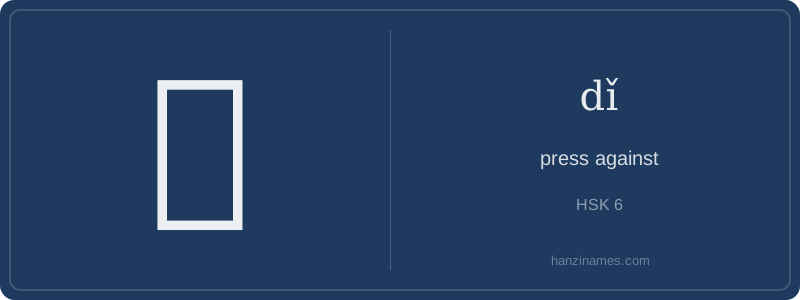
抵 is widely used in modern Chinese legal, financial, and everyday language. It appears in key terms like 抵押 (dǐyà, 'mortgage') — where property is pledged as security — and 抵抗 (dǐkàng, 'resist'), famously used in historical discourse like 抗日战争 (War of Resistance Against Japan). The idiom 以一当十 (yǐ yī dāng shí, 'one equals ten') often pairs with 抵 to express heroic defense. In spoken Mandarin, 抵 is also common in colloquial phrases like 抵不住 (dǐ bù zhù, 'can’t withstand') — e.g., 'I can’t resist this dessert!'
The character evolved from seal script, where 扌 (hand) combined with 底 (dǐ, 'base/foundation'). While not a pictograph, its structure reflects its semantic function: a hand acting upon a base — pressing, bracing, or anchoring. No oracle bone form survives, but its consistent use since the Warring States period confirms its early role in expressing opposition and support.
Hi there! Let’s learn 抵 (dǐ), an 8-stroke character with the hand radical 扌 — meaning it’s related to physical action. At its core, 抵 means 'to press against' or 'to support' — like using your hand to hold something steady, push back, or brace yourself. Think of leaning a ladder against a wall: your hand *presses* it firmly in place. This idea of resistance or mutual contact is central.
This character appears in many formal and everyday contexts — from finance ('offset debts') to martial arts ('block an attack') to emotions ('withstand pressure'). Though it’s HSK Level 6, its logic is very bodily and intuitive: 扌 (hand) + 底 (dǐ, 'bottom/base') suggests *using your hand to reach or hold the base* — anchoring, stabilizing, or countering force.
Don’t confuse 抵 with similar-sounding characters like 地 (dì, 'ground') or 低 (dī, 'low'). Its meaning depends heavily on context: it can be physical (pushing), abstract (resisting temptation), or transactional (offsetting). As you practice, notice how it often pairs with verbs like 抵抗 (resist), 抵押 (mortgage), or 抵消 (cancel out) — each building on that core idea of counterforce or support.
Example Sentences
Common Compounds
Similar Characters — Don't Mix These Up
Your First Step into Chinese Culture: Get a Chinese Name
Every journey into Chinese begins with a name. Use our free Chinese name generator to create a meaningful, personalized Chinese name that fits you perfectly.
Get My Chinese Name →