抛
Character Story & Explanation
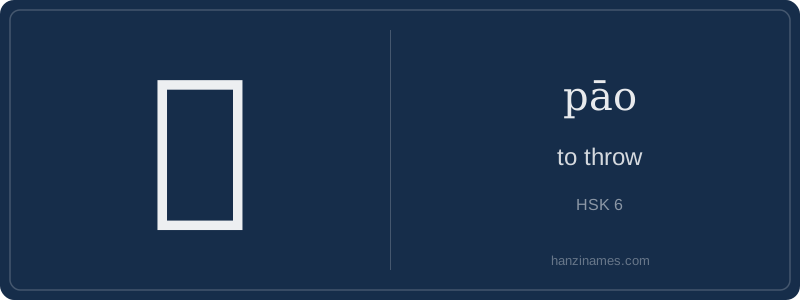
抛 is widely used in contemporary Mandarin in both literal and figurative senses: '抛锚' (pāo máo, 'to drop anchor') refers to a ship anchoring—but also jokingly means 'car breaking down'; '抛头露面' (pāo tóu lù miàn, 'to show one’s face publicly') describes appearing in public, historically implying risk for women in feudal times. It appears in the idiom '抛砖引玉' (pāo zhuān yǐn yù, 'throw a brick to attract jade'), meaning to offer a modest idea to prompt better ones—a common rhetorical device in meetings and essays.
The character evolved from seal script where 扌 (hand) combines with 九 (jiǔ, originally depicting a bent arm in motion, later phonetic). It is *not* pictographic but phono-semantic: 扌 signals action involving hands, while 九 provides sound approximation. No oracle-bone form survives; earliest attestation is in Warring States bamboo texts referring to discarding ritual offerings.
The character 抛 (pāo) embodies more than physical motion—it reflects a Chinese philosophical stance toward impermanence and intentional release. In Daoist and Buddhist-influenced thought, 'throwing away' is not wasteful but liberating: discarding attachments, outdated ideas, or emotional burdens aligns with the virtue of letting go (放下, fàngxià). This resonates deeply in modern contexts, from digital detox ('抛开手机'—throw aside the phone) to career pivots ('抛下铁饭碗'—abandon the 'iron rice bowl' of job security).
Unlike Western notions of throwing as mere expulsion, 抛 carries connotation of purposeful projection—sending something *forward* or *outward* with agency. Whether launching a question in debate (抛出问题), tossing a lifeline (抛绳), or casting doubt (抛出质疑), the act implies initiative and consequence. The hand radical 扌 underscores human intentionality: this is never accidental, but a conscious, embodied choice.
Its minimal stroke count (7) belies its semantic weight—each line is economical yet decisive, mirroring Confucian ideals of measured action. In classical poetry, 抛 appears in lines about scattering petals or casting off sorrow, linking natural imagery with inner transformation. Thus, 抛 is not just 'to throw' but 'to release with direction'—a linguistic microcosm of balance between action and non-attachment, effort and surrender, central to the Chinese worldview.
Example Sentences
Common Compounds
Similar Characters — Don't Mix These Up
Your First Step into Chinese Culture: Get a Chinese Name
Every journey into Chinese begins with a name. Use our free Chinese name generator to create a meaningful, personalized Chinese name that fits you perfectly.
Get My Chinese Name →