拘
Character Story & Explanation
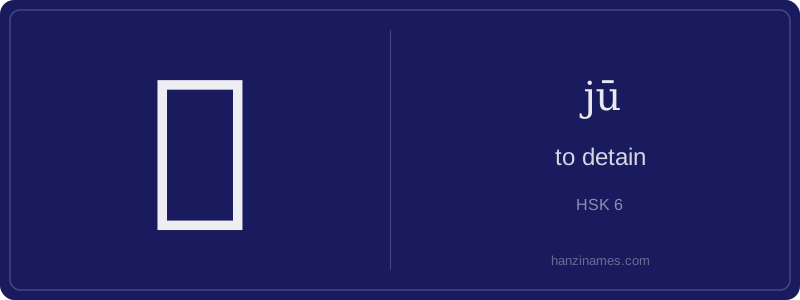
In modern China, 拘 is most commonly encountered in legal and administrative contexts—especially in phrases like 刑事拘留 (xíngshì jūliú, 'criminal detention'), a formal 3–7-day pre-arrest custody authorized by public security organs. It appears in official notices, court rulings, and CCTV legal programs. The idiom 拘谨 (jū jǐn, 'overly reserved') reflects its extended use for psychological constraint. Historically, the *Tang Code* (653 CE) explicitly defined 拘 as lawful physical apprehension by magistrates—never private action.
The character is not pictographic; its origin lies in the Bronze Script form where 扌 + 句 represented ‘hand applying structured control’. 句 originally depicted a bent object (like a hook or curve), suggesting containment—not a literal ‘sentence’. No oracle bone form survives, but Shuowen Jiezi (121 CE) defines it as ‘to hold tightly, to detain’, confirming its early juridical usage.
Imagine a bustling Beijing subway station at rush hour. A man suddenly collapses near Exit C. Bystanders quickly form a circle—not to gawk, but to protect him while waiting for help. An officer arrives and gently places his hand on the man’s shoulder, not to restrain, but to stabilize—this subtle, protective touch embodies the original nuance of 拘: not brute force, but controlled, purposeful containment. Historically, 拘 implied lawful, procedural restraint—like a magistrate securing a suspect with minimal force, preserving dignity even in detention.
The character’s radical 扌 (hand) signals physical action, while the phonetic component 句 (jù) hints at structure and boundaries—like drawing a line or defining limits. In classical texts such as the *Zuo Zhuan*, 拘 appears in contexts of formal arrest by officials, always tied to legal authority—not vigilante action. Its eight strokes reflect precision: three hand-related strokes (扌), then five forming 句, symbolizing measured, rule-bound intervention.
Today, 拘 retains this connotation of official, temporary restriction. It’s never used for casual grabbing or holding—it carries weight, legality, and consequence. You’ll see it on police notices, court documents, and news headlines about ‘criminal detention’. Even in idioms like 拘泥 (jū ní, ‘to be overly rigid’), the core idea persists: being bound by fixed rules, as if mentally ‘captured’ by convention. This semantic thread—from physical arrest to cognitive constraint—makes 拘 uniquely layered among Chinese verbs of control.
Example Sentences
Common Compounds
Similar Characters — Don't Mix These Up
Your First Step into Chinese Culture: Get a Chinese Name
Every journey into Chinese begins with a name. Use our free Chinese name generator to create a meaningful, personalized Chinese name that fits you perfectly.
Get My Chinese Name →