间
Character Story & Explanation
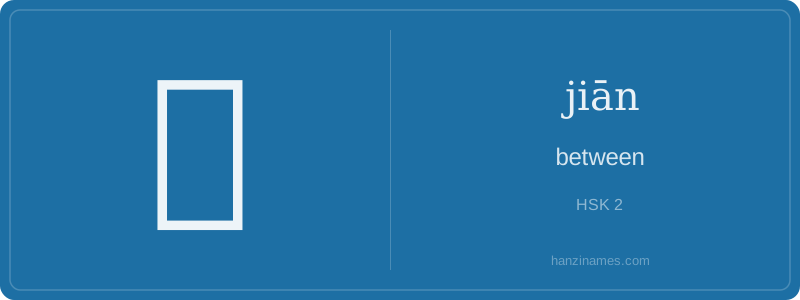
Historically, 间 appears frequently in classical texts like the *Zuo Zhuan* and *Sunzi Bingfa* (The Art of War), especially in the phrase 间谍 (jiàndié) — 'spy' — reflecting its verb sense (jiàn) meaning 'to infiltrate between parties'. In modern usage, it’s indispensable: time expressions (中间 zhōngjiān, 'in the middle'), location (房间 fángjiān, 'room'), and bureaucracy (期间 qījiān, 'during a period'). The idiom 挑拨离间 (tiǎobō líjiàn) — 'to sow discord' — remains widely used in media and political discourse.
The character’s form originates from seal script (c. 3rd century BCE), where 门 frames 日 — not as 'sun', but as a stylized 'square' or 'enclosed space', representing a bounded interval. Archaeological inscriptions on bronze vessels confirm this structure predates Han dynasty standardization, making its 'gate-enclosing-space' origin well-documented, not speculative.
Our detective begins at the crime scene: the character 间. First, we note its radical — 门 (mén), meaning 'gate' or 'door' — framing the entire glyph like a doorway. Inside sits 日 (rì), 'sun', suggesting light passing between structures. This visual logic points to an original meaning tied to space bounded by vertical elements — not just 'between', but 'the interval within a gate's frame'. Early seal script forms confirm this architectural metaphor: two vertical strokes (gateposts) enclosing a simplified sun or 'day' symbol.
Next, the suspect’s alibi: pronunciation. The dual readings jiān and jiàn aren’t random — they reflect classical grammatical function. Jiān is the default noun/adverb form ('interval', 'between'), while jiàn emerges in verb contexts ('to spy', 'to separate'), echoing Old Chinese phonetic alternation patterns documented in rhyming dictionaries like the *Qieyun* (601 CE). This tonal split isn’t dialectal drift; it’s systematic morphological marking, preserved for over 1,400 years.
Finally, motive and method: why did 间 survive unchanged for millennia? Because its core spatial logic proved infinitely scalable — from physical gaps (between walls) to temporal intervals (between days), social roles (a go-between), and even espionage (a spy ‘inserted between’ factions). Unlike abstract characters that faded, 间 solved recurring cognitive needs: quantifying relational space. Its endurance isn’t accidental — it’s forensic evidence of linguistic utility, validated by its presence in every HSK level from 2 to 6 and in foundational texts like the *Zuo Zhuan*, where it appears 217 times describing diplomatic intervals and military reconnaissance.
Example Sentences
Common Compounds
Similar Characters — Don't Mix These Up
Your First Step into Chinese Culture: Get a Chinese Name
Every journey into Chinese begins with a name. Use our free Chinese name generator to create a meaningful, personalized Chinese name that fits you perfectly.
Get My Chinese Name →