挪
Character Story & Explanation
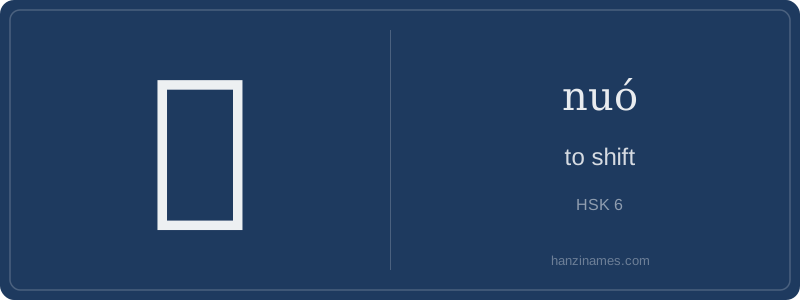
挪 is widely used in modern Mandarin for practical, everyday adjustments: moving furniture, reallocating budgets, or rescheduling meetings. It appears in official documents (e.g., 财政资金挪用 'misappropriation of fiscal funds') and colloquial speech (e.g., 挪个地方坐 'shift your seat'). The idiom 挪东补西 ('shift from east to cover west') describes unsustainable patchwork solutions—a documented phrase in 20th-century economic commentary.
挪 is a phono-semantic compound: radical 扌 (hand) signals physical action; phonetic component 那 (nà) hints at pronunciation (nuó evolved from Middle Chinese *nɑ). First attested in Song dynasty texts, it was standardized in modern dictionaries like the 1936 Dictionary of National Language. No oracle-bone or bronze script form exists—it emerged later as a functional character for administrative and domestic relocation.
The Chinese character 挪 (nuó) conveys the idea of shifting, moving, or relocating something—often with intention, effort, or slight resistance. Unlike English 'move', which is broad and neutral, 挪 emphasizes small-scale, controlled displacement: repositioning a chair, transferring funds, or adjusting a schedule. It implies agency and deliberation—not abrupt motion but careful relocation.
In Western contexts, 'shift' is the closest functional equivalent—used in logistics ('shift inventory'), finance ('shift funds'), and labor ('shift work'). Yet 'shift' can imply change of state (e.g., 'shift in attitude'), whereas 挪 remains physically grounded and action-oriented. No English verb captures its precise nuance: not quite 'nudge', not quite 'reassign', but a blend of gentle force and purposeful relocation.
This character reflects a cultural emphasis on pragmatic adjustment rather than wholesale replacement. In Confucian-influenced pragmatism, 挪 suggests working within existing structures—shifting resources instead of discarding them. It resonates with concepts like 'making do' or 're-purposing', common in East Asian resource-conscious traditions. Its radical 扌 (hand) reinforces embodied, tactile intervention—hands-on problem-solving over abstract planning.
Example Sentences
Common Compounds
Similar Characters — Don't Mix These Up
Your First Step into Chinese Culture: Get a Chinese Name
Every journey into Chinese begins with a name. Use our free Chinese name generator to create a meaningful, personalized Chinese name that fits you perfectly.
Get My Chinese Name →