捆
Character Story & Explanation
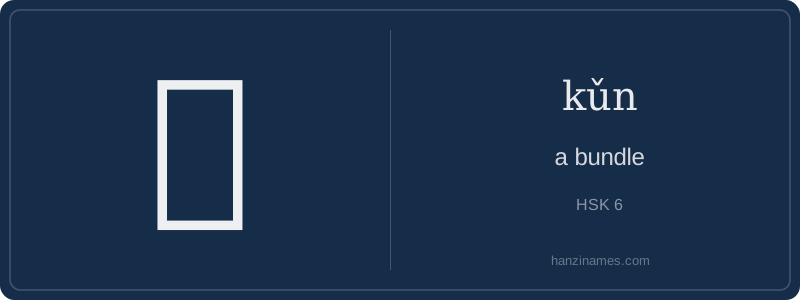
捆 is widely used in modern Chinese commerce and daily life—for example, 一捆葱 (yī kǔn cōng) means 'a bunch of scallions', a standard unit at wet markets across China. It also appears in idioms like 捆绑销售 (kǔn bǎng xiāo shòu), 'bundled sales', a common retail strategy regulated by China’s State Administration for Market Regulation since the 2000s. Historically, the character appears in Song Dynasty texts describing tax grain shipments tied in bundles for transport.
The character is not pictographic but phono-semantic: 扌 (hand radical) signals action; 困 (kùn) serves as both phonetic clue and semantic hint—its original oracle-bone form depicted a person enclosed in a compound, suggesting containment. Here, it reinforces the idea of 'binding into a contained unit'—a documented usage pattern confirmed in the *Shuōwén Jiězì* (100 CE) and later dictionaries.
Hi students! Let’s learn 捆 (kǔn), a Level 6 HSK character meaning 'a bunch' or 'to bind/tie together'. It’s not just about ropes—it’s about grouping things physically or conceptually. Notice the radical 扌 (hand) on the left: this tells us the action involves using your hands—like tying, bundling, or securing something. The right side, 困 (kùn), originally means 'to be trapped' or 'enclosed', so together they suggest 'using hands to enclose or secure items into a unit'.
This character is very practical—it appears in markets, logistics, packaging, and even digital contexts (e.g., bundling software features). Unlike abstract nouns, 捆 always implies quantity + cohesion: one 捆 of newspapers isn’t just 'some papers'—it’s a tied, countable unit. You’ll often see it with measure words like 一捆 (yī kǔn), never alone as a standalone noun without context.
Don’t confuse it with similar-sounding words like 昆 (kūn, 'insect') or 混 (hùn, 'to mix'). Pronunciation matters: kǔn has the third tone—falling then rising—so practice saying it like 'koo-en' with a dip. Writing it correctly matters too: 10 strokes, starting with the hand radical. Mastering 捆 helps you describe real-world organization—from street vendors’ bundled vegetables to online shopping ‘bundles’.
Example Sentences
Common Compounds
Similar Characters — Don't Mix These Up
Your First Step into Chinese Culture: Get a Chinese Name
Every journey into Chinese begins with a name. Use our free Chinese name generator to create a meaningful, personalized Chinese name that fits you perfectly.
Get My Chinese Name →