掐
Character Story & Explanation
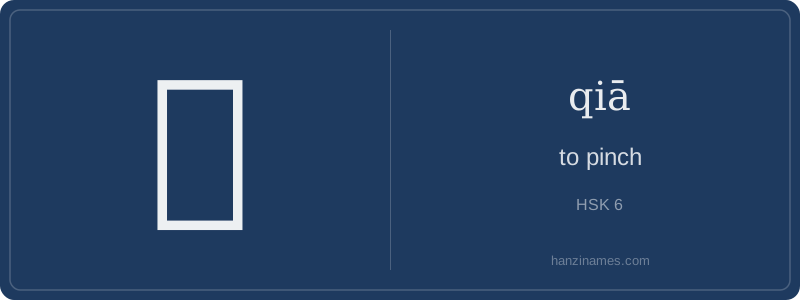
In modern Chinese daily life, 掐 most commonly appears in food preparation and traditional medicine. Cooks in Sichuan and Yunnan use 掐 to select tender bamboo shoots or young pea shoots—literally pinching off the succulent tips with thumb and forefinger. A well-documented phrase is 掐头去尾 (qiā tóu qù wěi), meaning 'to cut off the head and tail'—used idiomatically to describe editing a story or speech by removing unnecessary opening and closing parts. In TCM textbooks, 掐人中 (qiā rénzhōng) refers to stimulating the Renzhong acupoint (GV26) during fainting, a standard first-aid technique recorded in texts like the Compendium of Materia Medica (Bencao Gangmu, 1596).
The character is not pictographic; its earliest attestation is in clerical script (c. 3rd century BCE–3rd century CE). Its structure combines 扌 (hand) + 契 (phonetic, qì). There is no verified oracle-bone or bronze inscription form. Instead, think of a Shanghainese grandmother in her kitchen garden, kneeling beside a row of chrysanthemum greens, using her thumb and forefinger to qīa off the tenderest 3 cm—discarding fibrous stems, keeping only the sweet, crisp tips for stir-fry.
Imagine a bustling morning at Beijing’s Panjiayuan Antique Market, where a seasoned jade dealer swiftly qīa—not with scissors, but with thumb and forefinger—a tiny, translucent piece of nephrite from a raw slab. This isn’t casual handling—it’s precise, controlled pressure to test texture, density, and authenticity. The motion is deliberate: the thumb presses down while the index finger lifts up, creating subtle resistance. In traditional craftsmanship, this gesture separates genuine material from imitations—and it’s the very essence of 掐.
While ‘to pick’ is its basic gloss, 掐 carries visceral physicality: it implies gripping, pinching, or plucking with focused fingertip force—not broad grasping (抓) nor gentle touching (摸). It appears in contexts demanding tactile discernment: selecting ripe lychees by gently squeezing their skin, testing silk elasticity, or even performing acupuncture point stimulation (where practitioners ‘pinch and lift’ tissue before insertion).
The character’s radical 扌 (hand) anchors it in bodily action, while the phonetic component 契 (qì, meaning ‘to engrave’ or ‘to seal’) hints at precision and intentionality—like carving a contract into wood. At HSK 6, 掐 signals advanced lexical nuance: learners must grasp not just the verb, but its cultural weight in artisanal evaluation, culinary selection, and even martial arts (e.g., 掐喉, ‘to choke’). It’s never passive—it’s decisive, intimate, and skilled.
Example Sentences
Common Compounds
Similar Characters — Don't Mix These Up
Your First Step into Chinese Culture: Get a Chinese Name
Every journey into Chinese begins with a name. Use our free Chinese name generator to create a meaningful, personalized Chinese name that fits you perfectly.
Get My Chinese Name →