正
Character Story & Explanation
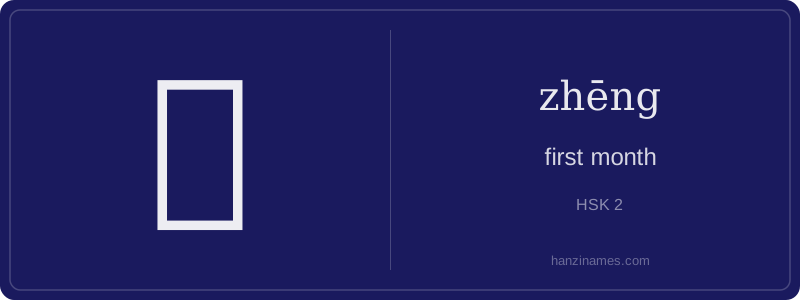
In modern Chinese life, 正 (zhēng) appears almost exclusively in 正月 (zhēngyuè), the traditional name for the first lunar month — a period filled with Spring Festival celebrations, family reunions, red envelopes, and temple fairs. This usage dates back over two millennia: the Zhou Dynasty (c. 1046–256 BCE) formalized the lunar calendar, and 正月 became the ceremonial 'inaugural month' — so named because it marked the beginning of the year and imperial reigns. It remains central in cultural discourse, appearing in poetry, almanacs, and official Spring Festival announcements.
The character 正 originated as a pictograph in oracle bone script: a foot (止) beneath a symbol for 'top' or 'uppermost' (一), conveying 'standing upright at the summit' or 'being first'. By the Warring States period, it had standardized into its current five-stroke form — still visually evoking centrality and priority.
Hello students! Today we’ll explore the character 正 — pronounced zhēng when it means 'the first month of the lunar year' (like in 正月, zhēngyuè). Though it’s more commonly heard as zhèng ('correct', 'upright'), this special zhēng reading is a classic example of Chinese tonal variation based on meaning and context. Don’t worry — it’s one of only a few characters with this kind of fixed literary pronunciation.
This character has just five strokes and belongs to the 止 (zhǐ) radical, which originally meant 'to stop' or 'foot'. In 正, that radical combines with a top stroke representing 'top' or 'beginning', hinting at 'firstness' — perfectly fitting its role for the lunar New Year’s opening month. Its simplicity makes it great for practicing stroke order: horizontal, vertical, horizontal, vertical, horizontal.
Remember: while zhèng is used in everyday words like 正确 (zhèngquè, 'correct') or 正在 (zhèngzài, 'currently'), you’ll *only* use zhēng in time-related contexts — especially 正月 (zhēngyuè). Native speakers switch seamlessly between these pronunciations, and mastering this distinction helps you sound more natural and avoid confusion with homophones like 征 (zhēng, 'to levy') or 争 (zhēng, 'to contend').
Example Sentences
Common Compounds
Similar Characters — Don't Mix These Up
Your First Step into Chinese Culture: Get a Chinese Name
Every journey into Chinese begins with a name. Use our free Chinese name generator to create a meaningful, personalized Chinese name that fits you perfectly.
Get My Chinese Name →