揉
Character Story & Explanation
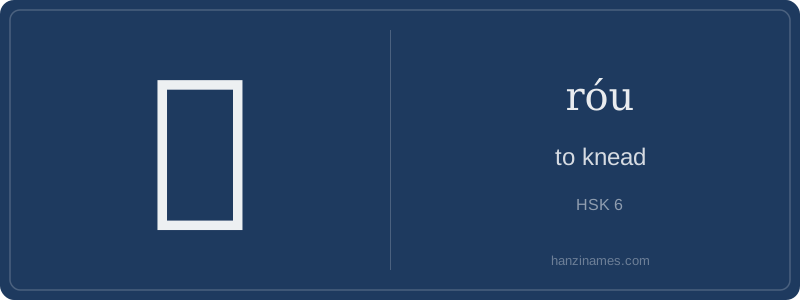
In daily life, 揉 appears in health contexts (e.g., 揉太阳穴 róu tàiyángxué — 'massage the temples'), culinary instructions ('揉面团 róu miàntuán — knead dough'), and idiomatic expressions like 揉搓 (róu cuō), meaning 'to torment emotionally'. It features in the classical medical term 揉法 (róu fǎ), one of the eight core TCM massage techniques documented in Ming-dynasty texts such as Zhenjiu Dacheng. Modern usage remains consistent: CCTV cooking shows, hospital physiotherapy pamphlets, and HSK-6 vocabulary lists all treat 揉 as the standard verb for controlled, circular, pressure-based manipulation.
The character’s form evolved from seal script (c. 220 BCE), where 扌 + 又 + 灬 suggested hand + ‘again’ + fire/dots—later standardized under Han clerical script. Though no oracle-bone form survives, excavated Warring States bamboo slips confirm 揉’s use in medicinal contexts. Today, Chinese learners practice its 12-stroke order on grid paper, tracing the hand radical first—just as ancient scribes did.
As an archaeologist sifting through layers of linguistic sediment, I find 揉 (róu) not carved in oracle bone but forged in the rhythmic press of human hands—kneading dough, massaging stiff shoulders, smoothing silk. Its radical 扌 (hand) anchors it firmly in embodied action, while the phonetic component 然 (rán) once signaled semantic resonance with 'to burn' or 'to be thus', later simplified to suggest continuity of motion. This character emerged fully in clerical script during the Han dynasty, shedding earlier pictographic ambiguity for precise tactile meaning.
The twelve strokes of 揉 map a choreography: first the hand’s grip (扌), then the yielding resistance of material—the curved stroke of 月 (here a variant of 肉, 'flesh') implying pliability, followed by 灬 (fire dots) transformed into 然’s lower component, now evoking sustained, gentle pressure rather than heat. Ancient medical texts like the Huangdi Neijing prescribe 揉 as therapeutic manipulation—evidence that its meaning was already standardized and clinically precise over two millennia ago.
Unlike characters born from celestial omens or ritual vessels, 揉 bears the quiet imprint of domestic labor: mothers kneading mantou dough before dawn, apothecaries grinding herbs into pastes, calligraphers rubbing inkstones to coax liquid blackness. Its endurance lies not in grandeur but in ubiquity—each stroke a fossilized gesture repeated across dynasties. To write 揉 is to reenact a somatic memory encoded in script: the palm pressing, rotating, yielding—not force, but informed persistence.
Example Sentences
Common Compounds
Similar Characters — Don't Mix These Up
Your First Step into Chinese Culture: Get a Chinese Name
Every journey into Chinese begins with a name. Use our free Chinese name generator to create a meaningful, personalized Chinese name that fits you perfectly.
Get My Chinese Name →